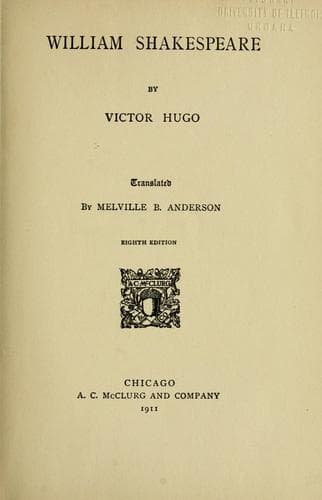
Dramatists, English -- Early modern, 1500-1700 -- Biography; Shakespeare, William, 1564-1616; Stratford-upon-Avon (England) -- Biography
We have just now recalled a saying become famous: "Art for art." Let
us, once for all, explain ourselves in this question. If faith can
be placed in an affirmation very general and very often repeated (we
believe honestly), these words, "Art for art," would have been written
by the author of this book himself. Written? Never! You may read, from
the first to the last line, all that we have published; you will not
find these words. It is the opposite which is written throughout our
works, and, we insist on it, in our entire life. As for these words
in themselves, how far are they real? Here is the fact, which several
of our contemporaries remember as well as we do. One day, thirty-five
years ago, in a discussion between critics and poets on Voltaire's
tragedies, the author of this book threw out this suggestion: "This
tragedy is not a tragedy. It is not men who live, it is sentences
which speak in it! Rather a hundred times 'Art for art!'" This remark
turned, doubtless involuntarily, from its true sense to serve the wants
of discussion, has since taken, to the great surprise of him who had
uttered it, the proportions of a formula. It is this opinion, limited
to "Alzire" and to the "Orpheline de la Chine," and incontestable in
that restricted application, which has been turned into a perfect
declaration of principles, and an axiom to inscribe on the banner of
art.
This point settled, let us go on.
Between two verses, the one by Pindar, deifying a coachman or
glorifying the brass nails of the wheel of a chariot, the other by
Archilochus, so powerful that, after having read it, Jeffreys would
leave off his career of crimes and would hang himself on the gallows
prepared by him for honest people,--between these two verses, of equal
beauty, I prefer that of Archilochus.
In times anterior to history, when poetry is fabulous and legendary,
it has a Promethean grandeur. What composes this grandeur? Utility.
Orpheus tames wild animals; Amphion builds cities; the poet, tamer and
architect, Linus aiding Hercules, Musæus assisting Dædalus, poetry a
civilizing power,--such is the origin. Tradition agrees with reason.
The common-sense of peoples is not deceived in that. It always invents
fables in the sense of truth. Everything is great in those magnifying
distances. Well, then, the wild-beast-taming poet that you admire in
Orpheus, recognize him in Juvenal.
Public-domain text, read in full here on John Shaqi.
Reviews
Reviews
No reviews yet
Be the first to share your thoughts on this work.
Elsewhere in the archive
Join the Discussion
Join the discussion
Sign in to leave a comment or review.
Sign InorCreate an account