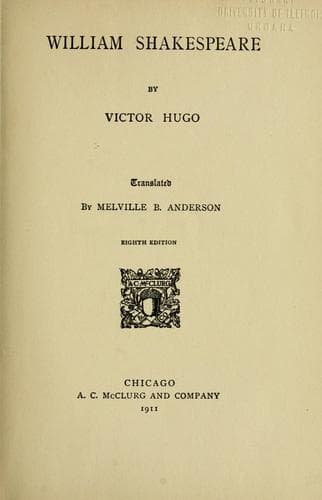
Dramatists, English -- Early modern, 1500-1700 -- Biography; Shakespeare, William, 1564-1616; Stratford-upon-Avon (England) -- Biography
We insist on Juvenal. Few poets have been more insulted, more
contested, more calumniated. Calumny against Juvenal has been drawn
at such long date that it lasts yet. It passes from one literary
clown to another. These grand haters of evil are hated by all the
flatterers of power and success. The mob of fawning sophists, of
writers who have around the neck the mark of their slavery, of bullying
historiographers, of scholiasts kept and fed, of court and school
followers, stand in the way of the glory of the punishers and avengers.
They croak around those eagles. People do not willingly render justice
to the dispensers of justice. They hinder the masters and rouse the
indignation of the lackeys. There is such a thing as the indignation of
baseness.
Moreover, the diminutives cannot do less than help one another, and
Cæsarion must at least have Tyrannion as a support The pedant snaps
the ferules for the benefit of the satrap. There is for this kind of
work a literary sycophancy and an official pedagogism. These poor,
dear-paying vices; these excellent indulgent crimes; his Highness
Rufinus; his Majesty Claudius; that august Madame Messalina who gives
such beautiful _fêtes_, and pensions out of her privy purse, and who
lasts and who is perpetuated, always crowned, calling herself Theodora,
then Fredegonde, then Agnes, then Margaret of Burgundy, then Isabel
of Bavaria, then Catherine de Medici, then Catherine of Russia, then
Caroline of Naples, etc.,--all these great lords, crimes, all these
fine ladies, turpitudes, shall they have the sorrow of witnessing
the triumph of Juvenal! No. War with the scourge in the name of
sceptres! War with the rod in the name of the shop! That is well! Go
on, courtiers, clients, eunuchs, and scribes. Go on, publicans and
pharisees. You will not hinder the republic from thanking Juvenal, or
the temple from approving Jesus.
Isaiah, Juvenal, Dante,--they are virgins. Observe their eyes cast
down. There is chastity in the anger of the just against the unjust.
The Imprecation can be as holy as the Hosanna; and indignation, honest
indignation, has the very purity of virtue. In point of whiteness, the
foam has no reason to envy the snow.
CHAPTER III.
History proves the working partnership of art and progress. _Dictus ob
hoc lenire tigres._ Rhythm is a power,--a power that the Middle Ages
recognize and submit to not less than antiquity. The second barbarism,
feudal barbarism, dreads also this power,--poetry. The barons, not
over-timid, are abashed before the poet. Who is this man? They fear
lest a manly song be sung. The spirit of civilization is with this
unknown. The old donjons full of carnage open their wild eyes, and
suspect the darkness; anxiety seizes hold of them. Feudality trembles;
the den is disturbed. The dragons and the hydras are ill at ease. Why?
Because an invisible god is there.
Public-domain text, read in full here on John Shaqi.
Reviews
Reviews
No reviews yet
Be the first to share your thoughts on this work.
Elsewhere in the archive
Join the Discussion
Join the discussion
Sign in to leave a comment or review.
Sign InorCreate an account