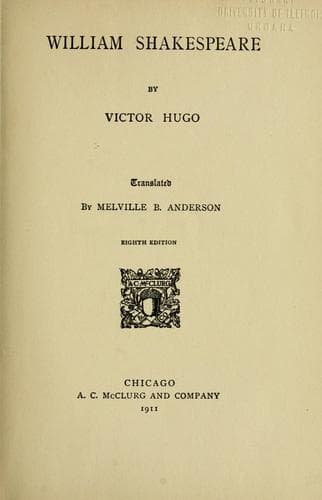
Dramatists, English -- Early modern, 1500-1700 -- Biography; Shakespeare, William, 1564-1616; Stratford-upon-Avon (England) -- Biography
Octavius Augustus, on the morning of the battle of Actium, met an ass
that the owner called Triumphus. This Triumphus, endowed with the
faculty of braying, appeared to him of good omen; Octavius Augustus
won the battle, remembered Triumphus, had the ass carved in bronze and
placed in the Capitol. That made a Capitoline ass, but still an ass.
One can understand kings saying to the poet, "Be useless;" but one
does not understand the people saying so to him. The poet is for the
people. "Pro populo poëta," wrote Agrippa d'Aubigné; "All things to
all men," exclaimed Saint Paul. What is a mind? A feeder of souls.
The poet is at the same time a menace and a promise. The anxiety
with which he inspires oppressors calms and consoles the oppressed.
It is the glory of the poet that he places a restless pillow on the
purple bed of the tormentors; and, thanks to him, it is often that
the tyrant awakes, saying, "I have slept badly." Every slavery,
every disheartening faintness, every sorrow, every misfortune, every
distress, every hunger, and every thirst have a claim on the poet; he
has one creditor,--the human race.
To be the great servant does not certainly derogate from the poet.
Because on certain occasions, and to do his duty, he has uttered the
cry of a people; because he has, when necessary, the sob of humanity
in his breast,--every voice of mystery sings not the less in him.
Speaking so loudly does not prevent him speaking low. He is not less
the confidant, and sometimes the confessor, of hearts. He is not less
intimately connected with those who love, with those who think, with
those who sigh, thrusting his head in the twilight between the heads
of two lovers. The love poems of André Chénier, without losing any
of their characteristics, border on the angry iambic: "Weep thou, O
Virtue, if I die!" The poet is the only living being to whom it is
granted both to thunder and to whisper, because he has in himself,
like Nature, the rumbling of the cloud and the rustling of the leaf.
He exists for a double function,--a function individual and a public
function: and it is for that that he requires, so to speak, two souls.
Ennius said: "I have three of them,--an Oscan soul, a Greek soul, and a
Latin soul." It is true that he made allusion only to the place of his
birth, to the place of his education, and to the place where he was a
citizen; and besides, Ennius was but a rough cast of a poet, vast, but
unformed.
No poet without that activity of soul which is the resultant of
conscience. The ancient moral laws require to be stated; the new moral
laws require to be revealed. These two series do not coincide without
some effort. That effort is incumbent on the poet He assumes constantly
the function of the philosopher. He must defend, according to the
side attacked, now the liberty of the human mind, now the liberty of
the human heart,--to love being no less holy than to think. There is
nothing of "Art for art" in all that.
Public-domain text, read in full here on John Shaqi.
Reviews
Reviews
No reviews yet
Be the first to share your thoughts on this work.
Elsewhere in the archive
Join the Discussion
Join the discussion
Sign in to leave a comment or review.
Sign InorCreate an account