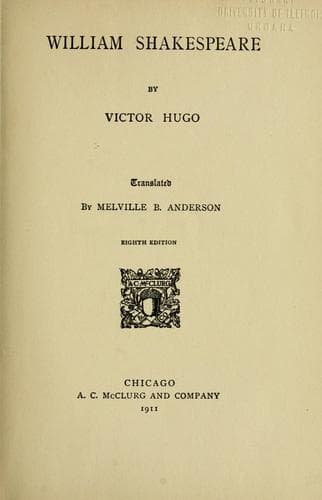
Dramatists, English -- Early modern, 1500-1700 -- Biography; Shakespeare, William, 1564-1616; Stratford-upon-Avon (England) -- Biography
The poet arrives in the midst of those goers and comers that we call
the living, in order to tame, like ancient Orpheus, the tiger in
man,--his evil instincts,--and, like the legendary Amphion, to remove
the stumbling-blocks of prejudice and superstition, to set up the new
blocks, to relay the corner-stones and the foundations, and to build up
again the city,--that is to say, society.
That this immense service--namely, to co-operate in the work of
civilization--should involve loss of beauty for poetry and of dignity
for the poet, is a proposition which one cannot enunciate without
smiling. Useful art preserves and augments all its graces, all its
charms, all its prestige. Indeed, because he has taken part with
Prometheus,--the man progress, crucified on the Caucasus by brutal
force, and gnawed at while alive by hatred,--Æschylus is not lowered.
Because he has loosened the ligatures of idolatry; because he has freed
human thought from the bands of religions tied over it (_arctis nodis
relligionum_), Lucretius is not diminished. The branding of tyrants
with the red-hot iron of prophecy does not lessen Isaiah; the defence
of his country does not taint Tyrtæus. The beautiful is not degraded
by having served liberty and the amelioration of human multitudes.
The phrase "a people enfranchised" is not a bad end to a strophe. No,
patriotic or revolutionary usefulness robs poetry of nothing. Because
the huge Grütli has screened under its cliffs that formidable oath of
three peasants from which sprang free Switzerland, it is all the same,
in the falling night, a lofty mass of serene shade alive with herds,
where are heard innumerable invisible bells tinkling gently under the
clear twilight sky.
[Footnote 1: Do not write _Beyle._]
PART III.--BOOK I.
CONCLUSION.
AFTER DEATH.--SHAKESPEARE.--ENGLAND.
CHAPTER I
In 1784, Bonaparte, then fifteen years old, arrived at the Military
School of Paris from Brienne, being one among four under the escort
of a minim priest. He mounted one hundred and seventy-three steps,
carrying his small trunk, and reached, below the roof, the barrack
chamber he was to inhabit. This chamber had two beds, and a small
window opening on the great yard of the school. The wall was
whitewashed; the youthful predecessors of Bonaparte had scrawled upon
this with charcoal, and the new-comer read in this little cell these
four inscriptions that we ourselves read thirty-five years ago:--
It takes rather long to win an epaulet.--_De Montgivray._
The finest day in life is that of a battle.--_Vicomte de
Tinténiac._
Life is but a long falsehood.--_Le Chevalier Adolphe Delmas._
All ends under six feet of earth.-_Le Comte de la Villette._
Public-domain text, read in full here on John Shaqi.
Reviews
Reviews
No reviews yet
Be the first to share your thoughts on this work.
Elsewhere in the archive
Join the Discussion
Join the discussion
Sign in to leave a comment or review.
Sign InorCreate an account