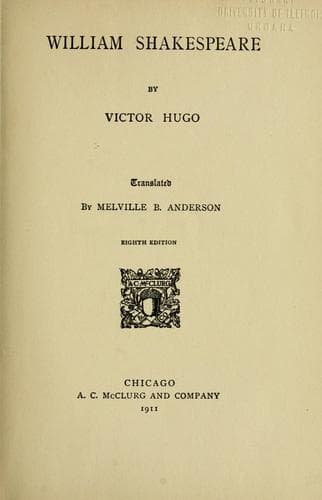
Dramatists, English -- Early modern, 1500-1700 -- Biography; Shakespeare, William, 1564-1616; Stratford-upon-Avon (England) -- Biography
On the dunghill like Job, under the stick like Epictetus, under
contempt like Molière, mind remains mind. This it is that shall say
the last word. The Caliph Almanzor makes the people spit on Averroes
at the door of the mosque of Cordova; the Duke of York spits in
person on Milton; a Rohan, almost a prince,--"duc ne daigne, Rohan
suis,"--attempts to cudgel Voltaire to death; Descartes is driven from
France in the name of Aristotle; Tasso pays for a kiss given a princess
twenty years spent in a cell; Louis XV. sends Diderot to Vincennes;
these are mere incidents; must there not be some clouds? Those
appearances that were taken for realities, those princes, those kings
melt away; there remains only what should remain,--the human mind on
the one side, the divine minds on the other; the true work and the true
workers; society to be perfected and made fruitful; science seeking
the true; art creating the beautiful; the thirst of thought, torment
and happiness of man; inferior life aspiring to superior life. Men
have to deal with real questions,--with progress in intelligence and by
intelligence. Men call to their aid the poets, prophets, philosophers,
thinkers, the inspired. It is seen that philosophy is a nourishment and
poetry a want. There must be another bread besides bread. If you give
up poets, you must give up civilization. There comes an hour when the
human race is compelled to reckon with Shakespeare the actor and Isaiah
the beggar.
They are the more present that they are no longer seen. Once dead,
these beings live.
What life did they lead? What kind of men were they? What do we know
of them? Sometimes but little, as of Shakespeare; often nothing, as
of those of ancient days. Has Job existed? Is Homer one, or several?
Méziriac made Æsop straight, and Planudes made him a hunchback.
Is it true that the prophet Hosea, in order to show his love for
his country, even when fallen into opprobrium and become infamous,
espoused a prostitute, and called his children Mourning, Famine, Shame,
Pestilence, and Misery? Is it true that Hesiod ought to be divided
between Cumæ in Æolia, where he was born, and Ascra, in Bœotia,
where he had been brought up? Velleius Paterculus makes him live one
hundred and twenty years after Homer, of whom Quintilian makes him
contemporary. Which of the two is right? What matters it? The poets are
dead, their thought reigns. Having been, they are.
They do more work to-day among us than when they were alive. Others who
have departed this life rest from their labours; dead men of genius
work.
They work upon what? Upon minds. They make civilization.
"All ends under six feet of earth "? No; everything commences there.
No; everything germinates there. No; everything flowers in it, and
everything grows in it, and everything bursts forth from it, and
everything proceeds from it! Good for you, men of the sword, are these
maxims!
Lay yourselves down, disappear, lie in the grave, rot. So be it.
Public-domain text, read in full here on John Shaqi.
Reviews
Reviews
No reviews yet
Be the first to share your thoughts on this work.
Elsewhere in the archive
Join the Discussion
Join the discussion
Sign in to leave a comment or review.
Sign InorCreate an account