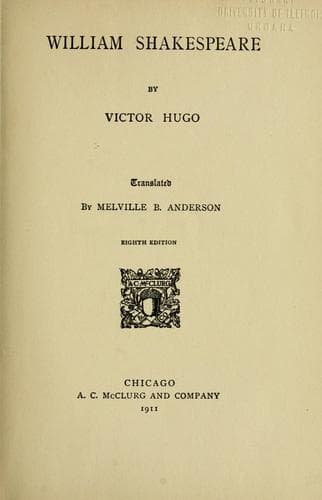
Dramatists, English -- Early modern, 1500-1700 -- Biography; Shakespeare, William, 1564-1616; Stratford-upon-Avon (England) -- Biography
By substituting for "an epaulet" "an empire,"--a very slight
change,--the above four inscriptions were all the destiny of Bonaparte,
and a kind of "Mene Tekel Upharsin" written beforehand upon that wall.
Desmazis, junior, who accompanied Bonaparte, being his room-mate, and
about to occupy one of the two beds, saw him take a pencil (it is
Desmazis who has related the fact) and draw beneath the inscriptions
that he had just read a rough sketch of his house at Ajaccio; then, by
the side of that house, without suspecting that he was thus bringing
near the island of Corsica another mysterious island then hid in the
deep future, he wrote the last of the four sentences: "All ends under
six feet of earth."
Bonaparte was right. For the hero, for the soldier, for the man of the
material fact, all ends under six feet of earth; for the man of the
idea everything commences there.
Death is a power.
For him who has had no other action but that of the mind, the tomb is
the elimination of the obstacle. To be dead, is to be all-powerful.
The man of war is formidable while alive; he stands erect, the earth
is silent, _siluit_; he has extermination in his gesture; millions of
haggard men rush to follow him,--a fierce horde, sometimes a ruffianly
one; it is no longer a human head, it is a conqueror, it is a captain,
it is a king of kings, it is an emperor, it is a dazzling crown of
laurels which passes, throwing out lightning flashes, and allowing
to be seen in starlight beneath it a vague profile of Cæsar. All
this vision is splendid and impressive; but let only a gravel come
in the liver, or an excoriation to the pylorus,--six feet of ground,
and all is said. This solar spectrum vanishes. This tumultuous life
falls into a hole; the human race pursues its way, leaving behind
this nothingness. If this man hurricane has made some lucky rupture,
like Alexander in India, Charlemagne in Scandinavia, and Bonaparte
in ancient Europe, that is all that remains of him. But let some
passer-by, who has in him the ideal, let a poor wretch like Homer throw
out a word in the darkness, and die,--that word burns up in the gloom
and becomes a star.
This vanquished one, driven from one town to another, is called Dante
Alighieri,--take care! This exiled one is called Æschylus, this
prisoner is called Ezekiel,--beware! This one-handed man is winged,--it
is Michael Cervantes. Do you know whom you see wayfaring there before
you? It is a sick man, Tyrtæus; it is a slave, Plautus; it is a
labourer, Spinoza; it is a valet, Rousseau. Well, that degradation,
that labour, that servitude, that infirmity, is power,--the supreme
power, mind.
Public-domain text, read in full here on John Shaqi.
Reviews
Reviews
No reviews yet
Be the first to share your thoughts on this work.
Elsewhere in the archive
Join the Discussion
Join the discussion
Sign in to leave a comment or review.
Sign InorCreate an account