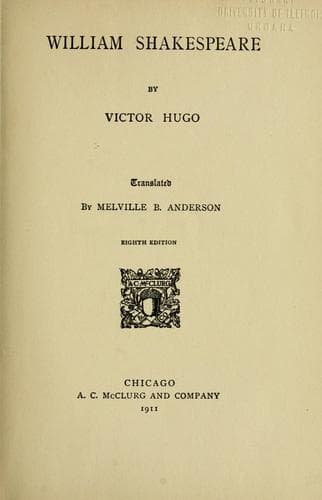
Dramatists, English -- Early modern, 1500-1700 -- Biography; Shakespeare, William, 1564-1616; Stratford-upon-Avon (England) -- Biography
wants two of them,--the king of the Centre, a Tartar, and the king of
Heaven (Tien Wang), a Chinese. O earth! throne of stupidity.
CHAPTER III.
The glory of Shakespeare reached England from abroad. There was almost
a day and an hour when one might have assisted at the landing of his
fame at Dover.
It required three hundred years for England to begin to hear those two
words that the whole world cries in her ear: "William Shakespeare."
What is England? She is Elizabeth. There is no incarnation more
complete. In admiring Elizabeth, England loves her own looking-glass.
Proud and magnanimous, yet full of strange hypocrisies; great, yet
pedantic; haughty, albeit able; prudish, yet audacious; having
favourites but no masters; her own mistress, even in her bed;
all-powerful queen, inaccessible woman,--Elizabeth is a virgin as
England is an island. Like England, she calls herself Empress of the
Sea, _Basilea maris._ A fearful depth, in which are let loose the angry
passions which behead Essex and the tempests which destroy the Armada,
defends this virgin and defends this island from every approach.
The ocean is the guardian of this modesty. A certain celibacy, in
fact, constitutes all the genius of England. Alliances, be it so; no
marriage. The universe always kept at some distance. To live alone,
to go alone, to reign alone, to be alone,--such is Elizabeth, such is
England.
On the whole, a remarkable queen and an admirable nation.
Shakespeare, on the contrary, is a sympathetic genius. Insularism is
his ligature, not his strength. He would break it willingly. A little
more and Shakespeare would be European. He loves and praises France; he
calls her "the soldier of God." Besides, in that prudish nation he is
the free poet.
England has two books: one which she has made, the other which has made
her,--Shakespeare and the Bible. These two books do not agree together.
The Bible opposes Shakespeare.
Certainly, as a literary book, the Bible, a vast cup from the East,
more overflowing in poetry even than Shakespeare, might fraternize
with him; in a social and religious point of view, it abhors him.
Shakespeare thinks, Shakespeare dreams, Shakespeare doubts. There is in
him something of that Montaigne whom he loved. The "to be or not to be"
comes from the _que sais-je?_
Moreover, Shakespeare invents. A great objection. Faith excommunicates
imagination. In respect to fables, faith is a bad neighbour, and
fondles only its own. One recollects Solon's staff raised against
Thespis. One recollects the torch of Omar brandished over Alexandria.
The situation is always the same. Modern fanaticism has inherited
that staff and that torch. That is true in Spain, and is not false in
England. I have heard an Anglican bishop discuss the Iliad and condense
everything in this remark, with which he meant to annihilate Homer: "It
is not true." Now, Shakespeare is much more a "liar" than Homer.
Public-domain text, read in full here on John Shaqi.
Reviews
Reviews
No reviews yet
Be the first to share your thoughts on this work.
Elsewhere in the archive
Join the Discussion
Join the discussion
Sign in to leave a comment or review.
Sign InorCreate an account