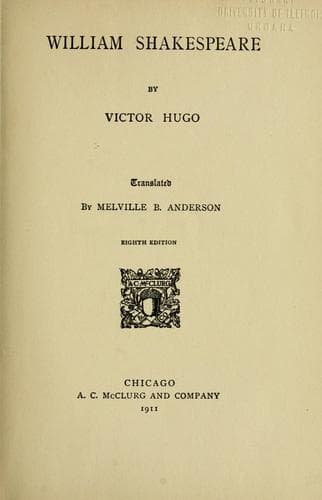
Dramatists, English -- Early modern, 1500-1700 -- Biography; Shakespeare, William, 1564-1616; Stratford-upon-Avon (England) -- Biography
Two or three years ago the journals announced that a French writer was
about to sell a novel for four hundred thousand francs. This made quite
a noise in England. A Conformist paper exclaimed, "How can a falsehood
be sold at such a price?"
Besides, two words, all-powerful in England, range themselves against
Shakespeare, and constitute an obstacle against him: "Improper,
shocking." Observe that, on a host of occasions, the Bible also is
"improper" and Holy Writ is "shocking." The Bible, even in French, and
through the rough lips of Calvin, does not hesitate to say, "Tu as
paillardé, Jerusalem." These crudities are part of poetry as well as of
anger; and the prophets, those angry poets, do not abstain from them.
Gross words are constantly on their lips. But England, where the Bible
is continually read, does not seem to realize it. Nothing equals the
power of voluntary deafness in fanatics. Would you have another example
of their deafness? At this hour Roman orthodoxy has not yet admitted
the brothers and sisters of Jesus Christ, although averred by the four
Evangelists. Matthew, may say, "Behold, thy mother and thy brethren
stand without.... And his brethren, James, and Joses, and Simon, and
Judas. And his sisters, are they not all with us?" Mark may insist:
"Is not this the carpenter, the son of Mary, the brother of James,
and Joses, and of Juda, and Simon? and are not his sisters here with
us?" Luke may repeat: "Then came to him his mother and his brethren."
John may again take up the question: "He, and his mother, and his
brethren.... Neither did his brethren believe in him.... But when his
brethren were gone up." Catholicism does not hear.
To make up for it, in the case of Shakespeare, "somewhat of a Pagan,
like all poets"[1] Puritanism has a delicate hearing. Intolerance
and inconsequence are sisters. Besides, in the matter of proscribing
and damning, logic is superfluous. When Shakespeare, by the mouth
of Othello, calls Desdemona "whore," general indignation, unanimous
revolt, scandal from top to bottom. Who then is this Shakespeare?
All the biblical sects stop their ears, without thinking that Aaron
addresses exactly the same epithet to Sephora, wife of Moses. It is
true that this is in an Apocryphal work, "The Life of Moses." But the
Apocryphal books are quite as authentic as the canonical ones.
Thence in England, for Shakespeare, a depth of irreducible coldness.
What Elizabeth was for Shakespeare, England is still,--at least we fear
so. We should be happy to be contradicted. We are more ambitious for
the glory of England than England is herself. This cannot displease her.
England has a strange institution,--"the poet laureate,"--which attests
the official admiration and a little the national admiration. Under
Elizabeth, England's poet was named Drummond.
Public-domain text, read in full here on John Shaqi.
Reviews
Reviews
No reviews yet
Be the first to share your thoughts on this work.
Elsewhere in the archive
Join the Discussion
Join the discussion
Sign in to leave a comment or review.
Sign InorCreate an account