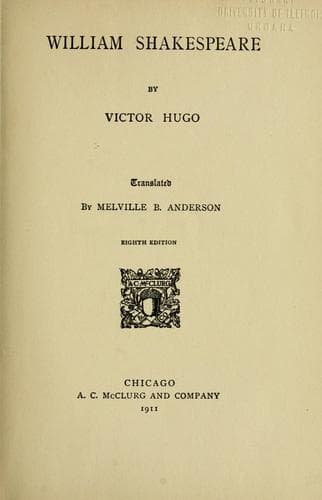
Dramatists, English -- Early modern, 1500-1700 -- Biography; Shakespeare, William, 1564-1616; Stratford-upon-Avon (England) -- Biography
Of course, we are no longer in the days when they placarded "Macbeth,
opera of Shakespeare, altered by Sir William Davenant." But if
"Macbeth" is played, it is before a small audience. Kean and Macready
have tried and failed in the endeavour.
At this hour they would not play Shakespeare on any English stage
without erasing from the text the word _God_ wherever they find it. In
the full tide of the nineteenth century, the lord-chamberlain still
weighs heavily on Shakespeare. In England, outside the church, the
word God is not made use of. In conversation they replace "God" by
"Goodness." In the editions or in the representations of Shakespeare,
"God" is replaced by "Heaven." The sense suffers, the verse limps; no
matter. "Lord! Lord! Lord!" the last appeal of Desdemona expiring, was
suppressed by command in the edition of Blount and Jaggard in 1623.
They do not utter it on the stage. "Sweet Jesus!" would be a blasphemy;
a devout Spanish woman on the English stage is bound to exclaim, "Sweet
Jupiter!" Do we exaggerate? Would you have a proof? Let us open
"Measure for Measure." There is a nun, Isabella. Whom does she invoke?
Jupiter. Shakespeare had written "Jesus."[2]
The tone of a certain Puritanical criticism toward Shakespeare is, most
certainly, improved; yet the cure is not complete.
It is not many years since an English economist, a man of authority,
making, in the midst of social questions, a literary excursion,
affirmed in a lofty digression, and without exhibiting the slightest
diffidence, this:--
"Shakespeare cannot live because he has treated specially
foreign or ancient subjects--'Hamlet,' 'Othello,' 'Romeo and
Juliet,' 'Macbeth,' 'Lear,' 'Julius Cæsar,' 'Coriolanus,'
'Timon of Athens,' etc. Now, nothing is likely to live in
literature except matters of immediate observation and works
made on contemporary subjects."
What say you to the theory? We would not mention it if this system
had not met approvers in England and propagators in France. Besides
Shakespeare, it simply excludes from literary "life" Schiller,
Corneille, Milton, Virgil, Euripides, Sophocles, Æschylus, and Homer.
It is true that it surrounds with a halo of glory Aulus-Gellius and
Restif of Bretonne. O critic, this Shakespeare is not likely to live,
he is only immortal!
About the same time, another--English also, but of the Scotch
school, a Puritan of that discontented variety of which Knox is the
head--declared poetry childishness; repudiated beauty of style as an
obstacle interposed between the idea and the reader; saw in Hamlet's
soliloquy only "a cold lyricism," and in Othello's adieu to standards
and camps only "a declamation;" likened the metaphors of poets to
illustrations in books,--good for amusing babies; and showed a
particular contempt for Shakespeare, as besmeared from one end to the
other with that "illuminating process."
Public-domain text, read in full here on John Shaqi.
Reviews
Reviews
No reviews yet
Be the first to share your thoughts on this work.
Elsewhere in the archive
Join the Discussion
Join the discussion
Sign in to leave a comment or review.
Sign InorCreate an account