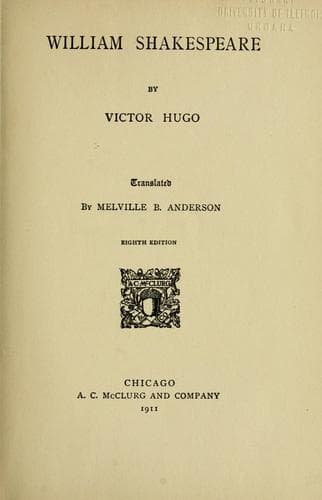
Dramatists, English -- Early modern, 1500-1700 -- Biography; Shakespeare, William, 1564-1616; Stratford-upon-Avon (England) -- Biography
Suppose a monument. Suppose it splendid; suppose it sublime,--a
triumphal arch, an obelisk, a circus with a pedestal in the centre, a
cathedral. No people is more illustrious, more noble, more magnificent,
and more magnanimous than the English people. Couple these two ideas,
England and Shakespeare, and make an edifice arise therefrom. Such
a nation celebrating such a man, it will be superb. Imagine the
monument, imagine the inauguration. The Peers are there, the Commons
give their adherence, the bishops officiate, the princes join the
procession, the queen is present. The virtuous woman in whom the
English people, royalist as we know, see and venerate their actual
personification,--this worthy mother, this noble widow, comes, with the
deep respect which is called for, to incline material majesty before
ideal majesty; the Queen of England salutes Shakespeare. The homage of
Victoria repairs the disdain of Elizabeth. As for Elizabeth, she is
probably there also, sculptured somewhere on the surbase, with Henry
VIII., her father, and James I., her successor,--pygmies beneath the
poet. The cannon booms, the curtain falls, they uncover the statue,
which seems to say, "At length!" and which has grown in the shade
during three hundred years,--three centuries; the growth of a colossus;
an immensity. All the York, Cumberland, Pitt, and Peel bronzes have
been made use of, in order to produce this statue; the public places
have been disencumbered of a heap of uncalled-for metal-castings;
in this lofty figure have been amalgamated all kinds of Henrys and
Edwards; the various Williams and the numerous Georges have been
melted, the Achilles in Hyde Park has made the great-toe. This is fine;
behold Shakespeare almost as great as a Pharaoh or a Sesostris. Bells,
drums, trumpets, applause, hurrahs.
What then?
It is honourable for England, indifferent to Shakespeare.
What is the salutation of royalty, of aristocracy, of the army, and
even of the English populace, ignorant yet to this moment, like
nearly all other nations,--what is the salutation of all these groups
variously enlightened to him who has the eternal acclamation, with its
reverberation, of all ages and all men? What orison of the Bishop of
London or of the Archbishop of Canterbury is worth the cry of a woman
before Desdemona, of a mother before Arthur, of a soul before Hamlet?
And thus, when universal outcry demands from England a monument to
Shakespeare, it is not for the sake of Shakespeare, it is for the sake
of England.
There are cases in which the repayment of a debt is of greater import
to the debtor than to the creditor.
Public-domain text, read in full here on John Shaqi.
Reviews
Reviews
No reviews yet
Be the first to share your thoughts on this work.
Elsewhere in the archive
Join the Discussion
Join the discussion
Sign in to leave a comment or review.
Sign InorCreate an account