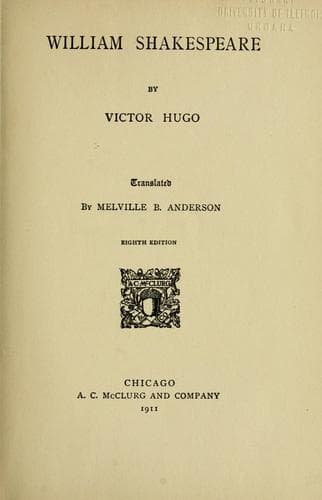
Dramatists, English -- Early modern, 1500-1700 -- Biography; Shakespeare, William, 1564-1616; Stratford-upon-Avon (England) -- Biography
A monument is an example. The lofty head of a great man is a light.
Crowds, like the waves, require beacons above them. It is good that
the passer-by should know that there are great men. People may not
have time to read; they are forced to see. People pass by that way,
and stumble against the pedestal; they are almost obliged to raise the
head and to glance a little at the inscription. Men escape a book; they
cannot escape the statue. One day on the bridge of Rouen, before the
beautiful statue due to David d'Angers, a peasant mounted on an ass
said to me: "Do you know Pierre Corneille?" "Yes," I replied. "So do
I," he rejoined. "And do you know 'The Cid'?" I resumed. "No," said he.
To him, Corneille was the statue.
This beginning in the knowledge of great men is necessary to the
people. The monument incites them to know more of the man. They desire
to learn to read in order to know what this bronze means. A statue is
an elbow-thrust to ignorance.
There is then, in the execution of such monuments, popular utility as
well as national justice.
To perform what is useful at the same time as what is just, that will
at the end certainly tempt England. She is the debtor of Shakespeare.
To leave such a debt in abeyance is not a good attitude for the pride
of a people. It is a point of morality that nations should be good
payers in matters of gratitude. Enthusiasm is probity. When a man is a
glory in the face of his nation, that nation which does not perceive
the fact astounds the human race around.
CHAPTER VI.
England, as it is easy to foresee, will build a monument to her poet.
Public-domain text, read in full here on John Shaqi.
Reviews
Reviews
No reviews yet
Be the first to share your thoughts on this work.
Elsewhere in the archive
Join the Discussion
Join the discussion
Sign in to leave a comment or review.
Sign InorCreate an account