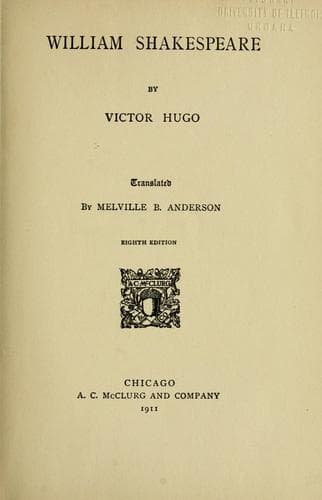
Dramatists, English -- Early modern, 1500-1700 -- Biography; Shakespeare, William, 1564-1616; Stratford-upon-Avon (England) -- Biography
A parenthesis. This word, romanticism, has, like all war-cries, the
advantage of readily summing up a group of ideas. It is brief,--which
pleases in the contest; but it has, to our idea, through its militant
signification, the objection of appearing to limit the movement that
it represents to a warlike action. Now, this movement is a matter of
intellect, a matter of civilization, a matter of soul; and this is why
the writer of these lines has never used the words _romanticism_ or
_romantic._ They will not be found in any of the pages of criticism
that he has had occasion to write. If to-day he derogates from his
usual prudence in polemics, it is for the sake of greater rapidity
and with all reservation. The same observation may be made on the
subject of the word _socialism_, which admits of so many different
interpretations.
The triple movement--literary, philosophical, and social--of the
nineteenth century, which is one single movement, is nothing but the
current of the revolution in ideas. This current, after having swept
away facts, is perpetuated in minds with all its immensity.
This term, "literary '93," so often quoted in 1830 against
contemporaneous literature, was not so much an insult as it
was intended to be. It was certainly as unjust to employ it as
characterizing the whole literary movement as it is iniquitous to
employ it to describe all the political revolutions; there is in these
two phenomena something besides '93. But this term, "literary '93," was
relatively exact, insomuch as it indicated, confusedly but truthfully,
the origin of the literary movement which belongs to our epoch, while
endeavouring to dishonour that movement. Here again the clairvoyance
of hatred was blind. Its daubings of mud upon the face of truth are
gilding, light, and glory.
The Revolution, turning climacteric of humanity, is made up of several
years. Each of these years expresses a period, represents an aspect, or
realizes a phase of the phenomenon. Tragic '93 is one of those colossal
years. Good news must sometimes have a mouth of bronze. Such a mouth is
'93.
Listen to the immense proclamation proceeding from it. Give attention,
remain speechless, and be impressed. God himself said the first time
_Fiat lux_, the second time he has caused it to be said.
By whom?
By '93.
Therefore, we men of the nineteenth century hold in honour that
reproach, "You are '93."
But do not stop there. We are '89 as well as '93. The Revolution,
the whole Revolution,--such is the source of the literature of the
nineteenth century.
Public-domain text, read in full here on John Shaqi.
Reviews
Reviews
No reviews yet
Be the first to share your thoughts on this work.
Elsewhere in the archive
Join the Discussion
Join the discussion
Sign in to leave a comment or review.
Sign InorCreate an account