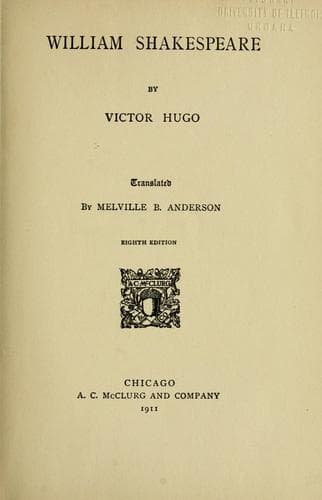
Dramatists, English -- Early modern, 1500-1700 -- Biography; Shakespeare, William, 1564-1616; Stratford-upon-Avon (England) -- Biography
CHAPTER I.
The nineteenth century springs from itself only; it does not receive
its impulse from any ancestor; it is the offspring of an idea.
Doubtless, Isaiah, Homer, Aristotle, Dante, Shakespeare, have been or
could be great starting-points for important philosophical or poetical
formations; but the nineteenth century has an august mother,--the
French Revolution. It has that powerful blood in its veins. It honours
men of genius. When denied it salutes them, when ignored it proclaims
them, when persecuted it avenges them, when insulted it crowns them,
when dethroned it replaces them upon their pedestal; it venerates
them, but it does not proceed from them. The nineteenth century has
for family itself, and itself alone. It is the characteristic of its
revolutionary nature to dispense with ancestors.
Itself a genius, it fraternizes with men of genius. As for its source,
it is where theirs is,--beyond man. The mysterious gestations of
progress succeed each other according to a providential law. The
nineteenth century is born of civilization. It has a continent to bring
into the world. France has borne this century; and this century bears
Europe.
The Greek stock bore civilization, narrow and circumscribed at first by
the mulberry leaf, confined to the Morea; then civilization, gaining
step by step, grew broader, and formed the Roman stock. It is to-day
the French stock,--that is to say, all Europe,--with young shoots in
America, Africa, and Asia.
The greatest of these young shoots is a democracy,--the United States,
the sprouting of which was aided by France in the last century. France,
sublime essayist in progress, has founded a republic in America before
making one in Europe. _Et vidit quod esset bonum._ After having lent
to Washington an auxiliary, Lafayette, France, returning home, gave to
Voltaire, dismayed within his tomb, that formidable successor, Danton.
In presence of the monstrous past, hurling every thunder, exhaling
every miasma, breathing every darkness, protruding every talon,
horrible and terrible, progress, constrained to use the same weapons,
has had suddenly a hundred arms, a hundred heads, a hundred tongues of
fire, a hundred roarings. The good has transformed itself into a hydra.
It is this that is termed the Revolution.
Nothing can be more august.
The Revolution ended one century and began another.
An intellectual awakening prepares the way for an overthrow of
facts,--and this is the eighteenth century. After which the political
revolution, once accomplished, seeks expression, and the literary and
social revolution completes it: this is the nineteenth century. With
ill-will, but not unjustly, has it been said that romanticism and
socialism are identical: hatred, in its desire to injure, very often
establishes, and, so far as is in its power, consolidates.
Public-domain text, read in full here on John Shaqi.
Reviews
Reviews
No reviews yet
Be the first to share your thoughts on this work.
Elsewhere in the archive
Join the Discussion
Join the discussion
Sign in to leave a comment or review.
Sign InorCreate an account