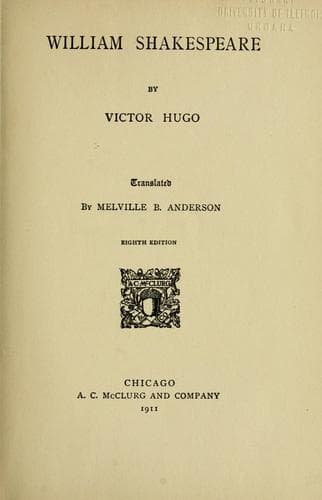
Dramatists, English -- Early modern, 1500-1700 -- Biography; Shakespeare, William, 1564-1616; Stratford-upon-Avon (England) -- Biography
Twelve years ago, in an island adjoining the coast of France, a house,
with a melancholy aspect in every season, became particularly sombre
because winter had commenced. The west wind, blowing then in full
liberty, made thicker yet round this abode those coats of fog that
November places between earthly life and the sun. Evening comes quickly
in autumn; the smallness of the windows added to the shortness of the
days, and deepened the sad twilight in which the house was wrapped.
The house, which had a terrace for a roof, was rectilinear, correct,
square, newly whitewashed,--a true Methodist structure. Nothing is
so glacial as that English whiteness; it seems to offer you the
hospitality of snow. One dreams with a seared heart of the old huts of
the French peasants, built of wood, cheerful and dark, surrounded with
vines.
To the house was attached a garden of a quarter of an acre, on an
inclined plane, surrounded with walls, cut in steps of granite, and
with parapets, without trees, naked, where one could see more stones
than leaves. This little uncultivated domain abounded in tufts of
marigold, which flourish in autumn, and which the poor people of the
country eat baked with the eel. The neighbouring seashore was hid from
this garden by a rise in the ground; on this rise there was a field of
short grass, where some nettles and a big hemlock flourished.
From the house you might perceive, on the right, in the horizon, on an
elevation, and in a little wood, a tower, which passed for haunted; on
the left you might see the dyke. The dyke was a row of big trunks of
trees, leaning against a wall, planted upright in the sand, dried up,
gaunt, with knots, ankylosès, and patellas, which looked like a row of
tibias. Revery, which readily accepts dreams for the sake of proposing
enigmas, might ask to what men these tibias of three fathoms in height
had belonged.
The south façade of the house looked on the garden, the north façade on
a deserted road.
A corridor at the entrance to the ground-floor, a kitchen, a
greenhouse, and a courtyard, with a little parlour, having a view of
the lonely road, and a pretty large study, scarcely lighted; on the
first and second floors, chambers, neat, cold, scantily furnished,
newly repainted, with white blinds to the window,--such was this
lodging, with the noise of the sea ever resounding.
This house, a heavy, right-angled white cube, chosen by those who
inhabited it apparently by chance, perhaps by intentional destiny, had
the form of a tomb.
Those who inhabited this abode were a group,--to speak more properly,
a family; they were proscribed ones. The most aged was one of those men
who, at a given moment, are _de trop_ in their own country. He had come
from an assembly; the others, who were young, had come from a prison.
To have written, that is sufficient motive for bars. Where shall
thought conduct except to a dungeon?
The prison had set them free into banishment.
Public-domain text, read in full here on John Shaqi.
Reviews
Reviews
No reviews yet
Be the first to share your thoughts on this work.
Join the Discussion
Join the discussion
Sign in to leave a comment or review.
Sign InorCreate an account