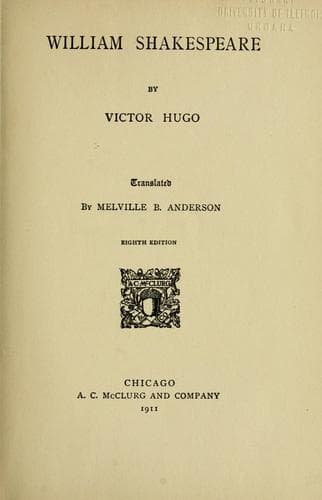
Dramatists, English -- Early modern, 1500-1700 -- Biography; Shakespeare, William, 1564-1616; Stratford-upon-Avon (England) -- Biography
The period of the men of brutal force is gone. They have been glorious,
certainly, but with a glory that melts away. That species of great men
is soluble in progress. Civilization rapidly oxidizes these bronzes.
At the point of maturity to which the French Revolution has already
brought the universal conscience, the hero is no longer a hero without
a good reason; the captain is discussed, the conqueror is inadmissible.
In our days Louis XIV. invading the Palatinate would look like a
robber. From the last century these realities began to dawn. Frederick
II., in the presence of Voltaire, felt and owned himself somewhat of
a brigand. To be a great man of matter, to be pompously violent, to
govern by the sword-knot and the cockade, to forge right upon force, to
hammer out justice and truth by blows of accomplished facts, to make
brutalities of genius,--is to be grand, if you like; but it is a coarse
manner of being grand,--glories announced with drums which are met with
a shrug of the shoulders. Sonorous heroes have deafened human reason
until to-day; that pompous noise begins now to weary it. It shuts
its eyes and ears before those authorized slaughters that they call
battles. The sublime murderers of men have had their time; it is in a
certain relative forgetfulness that henceforth they will be illustrious
and august; humanity, become greater, requires to dispense with them.
The food for guns thinks; it reflects, and is actually losing its
admiration for being shot down by a cannon-ball.
A few figures by the way may not be useless.
All tragedy is part of our subject. The tragedy of poets is not the
only one; there is the tragedy of politicians and statesmen. Would you
like to know how much that tragedy costs?
Heroes have an enemy; that enemy is called finance. For a long time
the amount of money paid for that kind of glory was ignored. In order
to disguise the total, there were convenient little fireplaces like
that in which Louis XIV. burned the accounts of Versailles. That day
the smoke of one thousand millions of francs passed out the chimney of
the royal stove. The nation did not even take notice. At the present
day nations have one great virtue,--they are miserly. They know that
prodigality is the mother of abasement. They reckon up; they learn
book-keeping by double entry. Warlike glory henceforth has its debit
and credit account: that renders it impossible.
The greatest warrior of modern times is not Napoleon, it is Pitt
Napoleon carried on warfare; Pitt created it. It is Pitt who willed all
the wars of the Revolution and of the empire; they proceeded from him.
Take away Pitt and put Fox in his place, there would then be no reason
for that exorbitant battle of twenty-three years, there would be no
longer any coalition. Pitt was the soul of the coalition, and he dead,
his soul remained amidst the universal war. What Pitt cost England and
the world, here it is. We add this bas-relief to his pedestal.
Public-domain text, read in full here on John Shaqi.
Reviews
Reviews
No reviews yet
Be the first to share your thoughts on this work.
Elsewhere in the archive
Join the Discussion
Join the discussion
Sign in to leave a comment or review.
Sign InorCreate an account