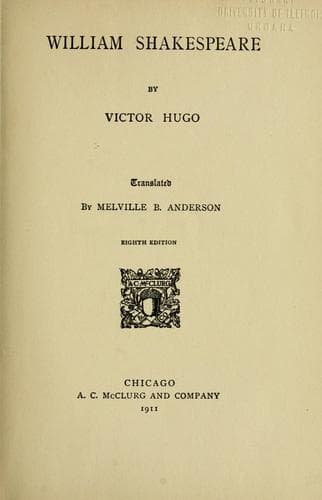
Dramatists, English -- Early modern, 1500-1700 -- Biography; Shakespeare, William, 1564-1616; Stratford-upon-Avon (England) -- Biography
The ingenuousness with which history glorifies the fact, whatever it
may be, and however impious it may be, shines nowhere better than
in Cantemir and Karamsin,--the one a Turkish historian, the other a
Russian historian. The Ottoman fact and the Muscovite fact evidence,
when confronted and compared with each other, the Tartar identity.
Moscow is not less sinisterly Asiatic than Stamboul. Ivan is in
the one as Mustapha is in the other. The gradation is imperceptible
between that Christianity and that Mahometanism. The Pope is brother
of the Ulema, the Boyard of the Pacha, the knout of the bowstring, and
the moujik of the mute. There is to men passing through the streets
little difference between Selim who pierces them with arrows, and
Basil who lets bears loose on them. Cantemir, a man of the South, an
ancient Moldavian hospodar, long a Turkish subject, feels, although he
has passed over to the Russians, that he does not displease the Czar
Peter by deifying despotism, and he prostrates his metaphors before
the sultans: this crouching upon the belly is Oriental, and somewhat
Western also. The sultans are divine; their scimitar is sacred,
their dagger is sublime, their exterminations are magnanimous, their
parricides are good. They call themselves merciful, as the furies are
called Eumenides. The blood that they spill smokes in Cantemir with
an odour of incense, and the vast slaughtering which is their reign
blooms into glory. They massacre the people in the public interest.
When some padischah (I know not which)--Tiger IV. or Tiger VI.--causes
to be strangled one after the other his nineteen little brothers
running frightened round the chamber, the Turkish native historian
declares that "it was executing wisely the law of the empire." The
Russian historian, Karamsin, is not less tender to the Tzar than was
Cantemir to the Sultan; nevertheless, let us say it, in comparison
with Cantemir's, the fervency of Karamsin is lukewarmness. Thus Peter,
killing his son Alexis, is glorified by Karamsin, but in the same tone
in which we excuse a fault. It is not the acceptation pure and simple
of Cantemir, who is more upon his knees. The Russian historian only
admires, while the Turkish historian adores. No fire in Karamsin, no
nerve,--a dull enthusiasm, grayish apotheoses, good-will struck into
an icicle, caresses benumbed with cold. It is poor flattery. Evidently
the climate has something to do with it. Karamsin is a chilled Cantemir.
Public-domain text, read in full here on John Shaqi.
Reviews
Reviews
No reviews yet
Be the first to share your thoughts on this work.
Elsewhere in the archive
Join the Discussion
Join the discussion
Sign in to leave a comment or review.
Sign InorCreate an account