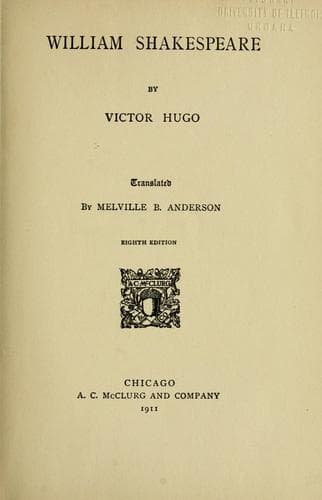
Dramatists, English -- Early modern, 1500-1700 -- Biography; Shakespeare, William, 1564-1616; Stratford-upon-Avon (England) -- Biography
In such history there is everything except history. Shows of princes,
of "monarchs," and of captains, indeed; but of the people, of laws,
of manners, very little; and of letters, of arts, of sciences, of
philosophy, of the universal movement of thought,--in one word, of
man,--nothing. Civilization dates by dynasties, and not by progress;
some king or other is one of the stages along the historical road;
the true stages, the stages of great men, are nowhere indicated. It
explains how Francis II. succeeds to Henri II., Charles IX. to Francis
II., and Henri III. to Charles IX.; but it does not tell us how Watt
succeeds to Papin, and Fulton to Watt; behind the heavy scenery of the
hereditary rights of kings a glimpse of the mysterious sovereignty
of men of genius is scarcely obtained. The lamp which smokes on the
opaque facades of royal accessions hides the starry light which the
creators of civilization throw over the ages. Not one of this series
of historians points out the divine relation of human affairs,--the
applied logic of Providence; not one makes us see how progress
engenders progress. That Philip IV. comes after Philip III., and
Charles II. after Philip IV., it would indeed be shameful not to know;
but that Descartes continues Bacon, and that Kant continues Descartes;
that Las Casas continues Columbus, that Washington continues Las Casas,
and that John Brown continues and rectifies Washington; that John Huss
continues Pelagius, that Luther continues John Huss, and that Voltaire
continues Luther,--it is almost a scandal to be aware of this!
[Footnote 1: There was but one John of England, who put to death (as
is supposed) his nephew Arthur, Duke of Bretagne. Perhaps this is what
Hugo had in mind.]
[Footnote 2: For Trajan, read Louis XV.]
CHAPTER IV.
It is time that all this should be altered. It is time that the men of
action should take their place behind, and the men of ideas come to the
front. The summit is the head. Where thought is, there is power. It is
time that men of genius should precede heroes. It is time to render to
Cæsar what is Cæsar's, and to the book what is the book's: such or such
a poem, such a drama, such a novel, does more work than all the Courts
of Europe together. It is time that history should proportion itself to
the reality, that it should allow to each influence its true measure,
and that it should cease to place the masks of kings on epochs made in
the image of poets and philosophers. To whom belongs the eighteenth
century,--to Louis XV. or to Voltaire? Confront Versailles with Ferney,
and see from which of these two points civilization flows.
Public-domain text, read in full here on John Shaqi.
Reviews
Reviews
No reviews yet
Be the first to share your thoughts on this work.
Elsewhere in the archive
Join the Discussion
Join the discussion
Sign in to leave a comment or review.
Sign InorCreate an account