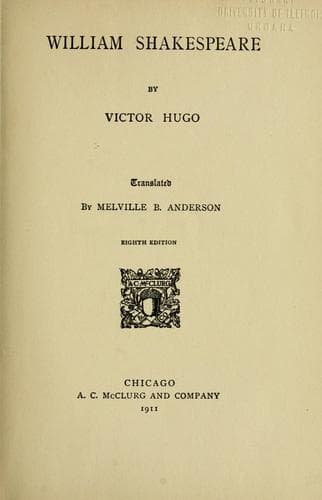
Dramatists, English -- Early modern, 1500-1700 -- Biography; Shakespeare, William, 1564-1616; Stratford-upon-Avon (England) -- Biography
In 1747, in the eighteenth century, under the gaze even of
philosophers, the battles of Raucoux and Lawfield, the siege of
Sas-de-Gand and the taking of Berg-op-Zoom, eclipse and efface
that sublime discovery which to-day is in course of modifying the
world,--electricity. Voltaire himself, about that year, celebrated
passionately some exploit of Trajan.[2]
A certain public stupidity is the result of that history which is
superimposed upon education almost everywhere. If you doubt it, see,
among others, the publications of Périsse Brothers, intended by the
editors, says a parenthesis, for primary schools.
A prince who gives himself an animal's name makes us laugh. We rail
at the Emperor of China, who makes people call him "His Majesty the
Dragon," and we placidly say "Monseigneur le Dauphin."
History is the record of domesticity. The historian is no more than the
master of ceremonies of centuries. In the model court of Louis the
Great there are four historians, as there are four chamber violinists.
Lulli leads the one, Boileau the others.
In this old method of history,--the only authorized method up to
1789, and classic in every acceptation of the word,--the best
narrators, even the honest ones (there are few of them), even those
who think themselves free, place themselves mechanically in drill,
stitch tradition to tradition, submit to accepted custom, receive the
pass-word from the antechamber, accept, pell-mell with the crowd,
the stupid divinity of coarse personages in the foreground,--kings,
"potentates," "pontiffs," soldiers,--and, all the time thinking
themselves historians, end by donning the livery of historiographers,
and are lackeys without knowing it.
This kind of history is taught, is compulsory, is commended and
recommended; all young intellects are more or less saturated with
it, its mark remains upon them, their thought suffers through it and
releases itself only with difficulty,--we make schoolboys learn it by
heart, and I who speak, when a child, was its victim.
Public-domain text, read in full here on John Shaqi.
Reviews
Reviews
No reviews yet
Be the first to share your thoughts on this work.
Elsewhere in the archive
Join the Discussion
Join the discussion
Sign in to leave a comment or review.
Sign InorCreate an account