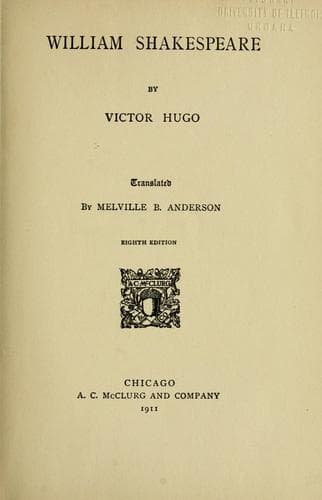
Dramatists, English -- Early modern, 1500-1700 -- Biography; Shakespeare, William, 1564-1616; Stratford-upon-Avon (England) -- Biography
4. Another, Isaiah, seems, above humanity, as a roaring of continual
thunder. He is the great censure. His style, a kind of nocturnal
cloud, lightens up unceasingly with images which suddenly empurple
all the depths of this dark mind, and makes us exclaim, "He gives
light!" Isaiah takes hand-to-hand the evil which, in civilization,
makes its appearance before the good. He cries "Silence!" at the
noise of chariots, of _fêtes_, of triumphs. The foam of his prophecy
surges even on Nature. He denounces Babylon to the moles and bats,
promises Nineveh briers, Tyre ashes, Jerusalem night, fixes a date for
the wrong-doers, warns the powers of their approaching end, assigns
a day against idols, high citadels, the fleets of Tarsus, the cedars
of Lebanon, the oaks of Basan. He is standing on the threshold of
civilization, and he refuses to enter. He is a kind of mouthpiece of
the desert speaking to multitudes, and claiming for quicksands, briers,
and breezes the place where towns are, because it is just; because the
tyrant and the slave--that is to say, pride and shame--exist wherever
there are walled enclosures; because evil is there incarnate in man;
because in solitude there is but the beast, while in the city there is
the monster. That which Isaiah made a reproach of in his day--idolatry,
pride, war, prostitution, ignorance--still exists. Isaiah is the
eternal contemporary of vices which turn valets, and crimes which exalt
themselves into kings.
5. Another, Ezekiel, is the wild soothsayer,--the genius of the
cavern; thought which the roar suits. But listen. This savage makes
a prophecy to the world,--Progress. Nothing more astonishing. Ah,
Isaiah overthrows? Very well! Ezekiel will reconstruct. Isaiah refuses
civilization. Ezekiel accepts, but transforms it. Nature and humanity
blend together in that softened howl which Ezekiel throws forth. The
idea of duty is in Job; of right, in Æschylus. Ezekiel brings before
us the resulting third idea,--the human race ameliorated, posterity
more and more free. That posterity may be a rising instead of a setting
star is man's consolation. Time present works for time to come. Work,
then, and hope. Such is Ezekiel's cry. Ezekiel is in Chaldæa; and
from Chaldæa he sees distinctly Judæa, as from oppression you may
see liberty. He declares peace as others declare war. He prophesies
harmony, goodness, sweetness, union, the blending of races, love.
Notwithstanding, he is terrible. He is the austere benefactor. He is
the universal kind-hearted grumbler at the human race. He scolds, he
almost gnashes his teeth; and people fear and hate him. The men about
are thorns to him. "I live among the briers," he says. He condemns
himself to be a symbol, and makes in his person, become hideous, a sign
of human misery and popular degradation. He is a kind of voluntary
Job. In his town, in his house, he causes himself to be bound with
cords, and rests mute: behold the slave. In the public place he eats
dung: behold the courtier.
Public-domain text, read in full here on John Shaqi.
Reviews
Reviews
No reviews yet
Be the first to share your thoughts on this work.
Join the Discussion
Join the discussion
Sign in to leave a comment or review.
Sign InorCreate an account