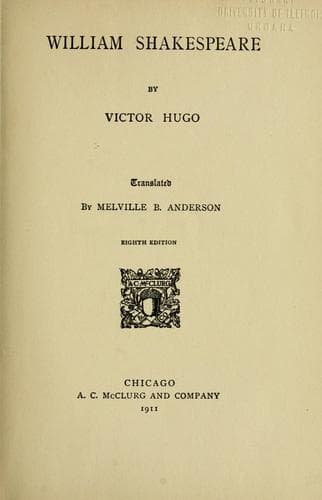
Dramatists, English -- Early modern, 1500-1700 -- Biography; Shakespeare, William, 1564-1616; Stratford-upon-Avon (England) -- Biography
7. Another, Juvenal, has everything in which Lucretius
fails,--passion, emotion, fever, tragic flame, passion for honesty,
avenging sneer, personality, humanity. He dwells in a certain given
point in creation, and he contents himself with it, finding there what
may nourish and swell his heart with justice and anger. Lucretius is
the universe, Juvenal the locality. And what a locality! Rome. Between
the two they are the double voice which speaks to land and town,--_urbi
et orbi._ Juvenal has, above the Roman Empire, the enormous flapping
of wings of the griffin above the rest of the reptiles. He pounces
upon this swarm and takes them, one after the other, in his terrible
beak,--from the adder who is emperor and calls himself Nero, to the
earthworm who is a bad poet and calls himself Codrus. Isaiah and
Juvenal have each their harlot; but there is something more gloomy than
the shadow of Babel,--it is the crashing of the bed of the Cæsars; and
Babylon is less formidable than Messalina. Juvenal is the ancient free
spirit of the dead republics; in him there is a Rome, in the bronze
of which Athens and Sparta are cast. Thence in his poetry something
of Aristophanes and something of Lycurgus. Take care of him; he is
severe. Not a cord is wanting to his lyre or to the lash he uses. He is
lofty, rigid, austere, thundering, violent, grave, just, inexhaustible
in imagery, harshly gracious when he chooses. His cynicism is the
indignation of modesty. His grace, thoroughly independent and a true
figure of liberty, has talons; it appears all at once, enlivening, by
we cannot tell what supple and spirited undulations, the well-formed
majesty of his hexameter. You may imagine that you see the Cat of
Corinth roaming on the frieze of the Parthenon. There is the epic in
this satire; that which Juvenal has in his hand is the sceptre of gold
with which Ulysses beat Thersites. "Bombast, declamation, exaggeration,
hyperbole," cry the slaughtered deformities; and these cries, stupidly
repeated by rhetoricians, are a noise of glory. "Crime is quite equal
to committing things or relating them," say Tillemont, Marc Muret,
Garasse, etc.,--fools, who, like Muret, are sometimes knaves. Juvenal's
invective blazes since two thousand years ago,--a fearful flash of
poetry which still burns Rome in the presence of centuries. This
splendid fire breaks out and, far from diminishing with time, increases
under the whirl of its mournful smoke. From it proceed rays in behalf
of liberty, probity, heroism; and it may be said that it throws even
into our civilization minds full of his light. What is Régnier? what
D'Aubigné? what Corneille?--scintillations of Juvenal.
Public-domain text, read in full here on John Shaqi.
Reviews
Reviews
No reviews yet
Be the first to share your thoughts on this work.
Join the Discussion
Join the discussion
Sign in to leave a comment or review.
Sign InorCreate an account