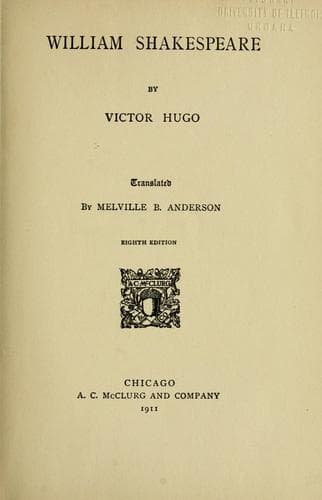
Dramatists, English -- Early modern, 1500-1700 -- Biography; Shakespeare, William, 1564-1616; Stratford-upon-Avon (England) -- Biography
This antipathy was quite fearful. The poet showed himself a
persecutor; he has lent assistance to the oppressors against the
oppressed, and his comedy has been guilty of crimes. Aristophanes
has remained in the eyes of posterity in the condition of a wicked
genius,--fearful punishment! But there is for him one attenuating
circumstance: he was an ardent admirer of the poet of "Prometheus,"
and to admire him was to defend him. Aristophanes did what he could to
prevent his banishment; and if anything can diminish one's indignation
in reading the "Clouds," implacable on Socrates, it is that one may
see in the background the hand of Aristophanes holding the mantle of
Æschylus going into exile. Æschylus has likewise a comedy, a sister of
the broad farce of Aristophanes. We have spoken of his mirth. It goes
very far in "The Argians." It equals Aristophanes, and outstrips the
Shrove Tuesday of our Carnival. Listen: "He throws at my head a chamber
utensil. The full vase falls on my head, and is broken, odoriferous,
but in a different manner from an urnful of perfume." Who says that?
Æschylus. And in his turn Shakespeare will come and will exclaim
through Falstaff's lips: "Empty the jorden." What can you say? You have
to deal with savages.
One of those savages is Molière: witness from one end to the other the
"Malade Imaginaire." Racine also is in a degree one of them: see "Les
Plaideurs," already mentioned.
The Abbé Camus was a witty bishop,--a rare thing at all times; and what
is more, he was a good man. He would have deserved this reproach of
another bishop: "Bon jusqu'à la bêtise." Perhaps he was good because he
had wit He gave to the poor all the revenue of his bishopric of Belley.
He objected to canonization. It was he who said, "Il n'est chasse que
de vieux chiens et châsse que de vieux saints;" and although he did
not like the new-comers in sanctity, he was a friend of Saint François
de Sales, by whose advice he wrote novels. He relates in one of his
letters that one day François de Sales said to him: "The Church laughs
readily."
Public-domain text, read in full here on John Shaqi.
Reviews
Reviews
No reviews yet
Be the first to share your thoughts on this work.
Elsewhere in the archive
Join the Discussion
Join the discussion
Sign in to leave a comment or review.
Sign InorCreate an account