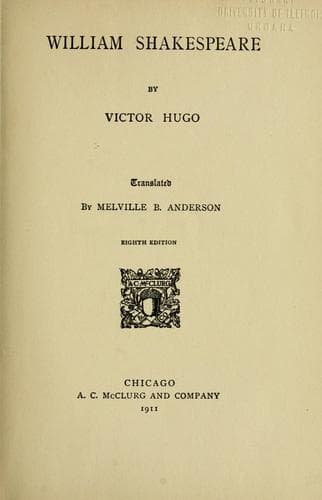
Dramatists, English -- Early modern, 1500-1700 -- Biography; Shakespeare, William, 1564-1616; Stratford-upon-Avon (England) -- Biography
Art also laughs readily. Art, which is a temple, has its laughter.
Whence comes this hilarity? All at once, in the midst of
_chefs-d'œuvre_, serious figures, a buffoon stands up and blurts
out,--a _chef-d'œuvre_ also. Sancho Panza jostles Agamemnon. All the
marvels of thought are there; irony comes to complicate and complete
them. Enigma. Behold art, great art, breaking into an excess of gayety.
Its problem, matter, amuses it. It was forming it, now it deforms it.
It was shaping it for beauty, now it delights in extracting from it
ugliness. It seems to forget its responsibility. It does not forget
it, however; for suddenly, behind the grimace, philosophy makes its
appearance,--a philosophy smooth, less sidereal, more terrestrial,
quite as mysterious as the grave philosophy. The unknown which is in
man, and the unknown which is in things, face each other; and it turns
out that in the act of meeting, these two augurs, Nature and Fate,
cannot keep their serious countenance. Poetry, laden with anxieties,
befools--whom? Itself. A mirth, which is not serenity, gushes out from
the incomprehensible. An unknown, lofty, and sinister raillery flashes
its lightning through the human darkness. The shadows piled up around
us play with our soul. Formidable blossoming of the unknown. The jest
proceeds from the abyss.
This alarming mirth in art is called, in olden times, Aristophanes, and
in modern times, Rabelais.
When Pratinas the Dorian had invented the play with satyrs, comedy
making its appearance opposite tragedy, mirth by the side of mourning,
the two styles ready perhaps to unite, it was a matter of scandal.
Agathon, the friend of Euripides, went to Dodona to consult Loxias.
Loxias is Apollo. Loxias means crooked; and Apollo was called The
Crooked, on account of his oracles being always obscure and full of
ambiguous meanings. Agathon inquired from Apollo whether the new
style was not impious, and whether comedy existed by right as well as
tragedy. Loxias answered, "Poetry has two ears."
This answer, which Aristotle declares obscure, seems to us very clear.
It sums up the entire law of art. Two problems, in fact, are presented.
In the full light the first problem,--noisy, tumultuous, stormy,
clamorous, the vast vital causeway, offering every direction to the
ten thousand feet of man; the quarrels, the uproar, the passions with
their _why_; the evil, which undergoes suffering the first, for to be
evil is worse than doing it; sorrows, griefs, tears, cries, rumours.
In the shade, the second one, mute problem, immense silence, with an
inexpressible and terrible meaning. And poetry has two ears,--one which
listens to life, the other which listens to death.
CHAPTER IX.
The power that Greece had to evolve her luminous effluvia is
prodigious,--even like that to-day which we see in France. Greece did
not colonize without civilizing,--an example that more than one modern
nation might follow. To buy and sell is not everything.
Public-domain text, read in full here on John Shaqi.
Reviews
Reviews
No reviews yet
Be the first to share your thoughts on this work.
Elsewhere in the archive
Join the Discussion
Join the discussion
Sign in to leave a comment or review.
Sign InorCreate an account