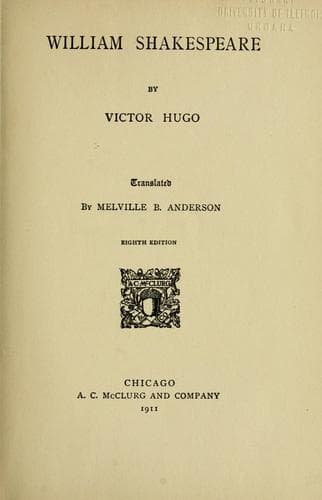
Dramatists, English -- Early modern, 1500-1700 -- Biography; Shakespeare, William, 1564-1616; Stratford-upon-Avon (England) -- Biography
Tyre bought and sold; Berytus bought and sold; Sidon bought and sold;
Sarepta bought and sold. Where are these cities? Athens taught; Athens
is still at this hour one of the capitals of human thought.
The grass is growing on the six steps of the tribune where spoke
Demosthenes; the Ceramicus is a ravine half-choked with the marble-dust
which was once the palace of Cecrops; the Odeon of Herod Atticus at
the foot of the Acropolis is now but a ruin on which falls, at certain
hours, the imperfect shadow of the Parthenon; the temple of Theseus
belongs to the swallows; the goats browse on the Pnyx. Still the Greek
spirit is living; still Greece is queen; still Greece is goddess. A
commercial firm passes away; a school remains.
It is curious to say to one's self to-day that twenty-two centuries
ago small towns, isolated and scattered on the outskirts of the known
world, possessed, all of them, theatres. In point of civilization,
Greece began always by the construction of an academy, of a portico,
or of a logeum. Whoever could have seen, nearly at the same period,
rising at a short distance one from the other, in Umbria, the Gallic
town of Sens (now Sinigaglia), and, near Vesuvius, the Hellenic city
Parthenopea (at present Naples), would have recognized Gaul by the big
stone standing all red with blood, and Greece by the theatre.
This civilization by poetry and art had such a mighty force that
sometimes it subdued even war. The Sicilians--Plutarch relates it in
speaking of Nicias--gave liberty to the Greek prisoners who sang the
verses of Euripides.
Let us point out some very little known and very singular facts.
Public-domain text, read in full here on John Shaqi.
Reviews
Reviews
No reviews yet
Be the first to share your thoughts on this work.
Elsewhere in the archive
Join the Discussion
Join the discussion
Sign in to leave a comment or review.
Sign InorCreate an account