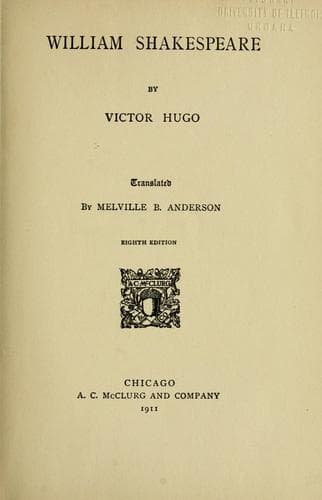
Dramatists, English -- Early modern, 1500-1700 -- Biography; Shakespeare, William, 1564-1616; Stratford-upon-Avon (England) -- Biography
Æschylus was for Greece the autochthonic poet. He was more than Greek,
he was Pelasgian. He was born at Eleusis; and not only was he Eleusian,
but Eleusiatic,--that is to say, a believer. It is the same shade as
English and Anglican. The Asiatic element, the grandiose deformation
of this genius, increased respect for it; for people said that the
great Dionysus, that Bacchus, common to the West and the East, came in
Æschylus's dreams to dictate to him his tragedies. You find again here
the "familiar spirit" of Shakespeare.
Æschylus, Eupatride, and Eginetic struck the Greeks as more Greek
than themselves. In those times of code and dogma mingled together,
to be sacerdotal was an elevated way of being national. Fifty-two
of his tragedies had been crowned. On leaving the theatre after the
performance of the plays of Æschylus, the men would strike the shields
hung at the doors of the temples, crying, "Fatherland, fatherland!" Let
us add here, that to be hieratic did not hinder him from being demotic.
Æschylus loved the people, and the people adored him. There are two
sides to greatness: majesty is one, familiarity is the other. Æschylus
was familiar with the turbulent and generous mob of Athens. He often
gave to that mob a fine part in his plays. See, in the "Orestias,"
how tenderly the chorus, which is the people, receive Cassandra! The
queen uses the slave roughly, and scares him whom the chorus tries to
reassure and soothe. Æschylus had introduced the people in his grandest
works,--in "Pentheus," by the tragedy of "The Woolcombers;" in "Niobe,"
by the tragedy of the "Nurses;" in "Athamas," by the tragedy of the
"Net-drawers;" in "Iphigenia," by the tragedy of the "Bed-Makers."
It was on the side of the people that he turned the balance in that
mysterious drama, "The Weighing of Souls."[1] Therefore had he been
chosen to preserve the sacred fire.
In all the Greek colonies they played the "Orestias" and "The
Persians." Æschylus being present, the fatherland was no longer absent.
The magistrates ordered these almost religious representations. The
gigantic Æschylean theatre was intrusted with watching over the infancy
of the colonies. It enclosed them in the Greek spirit, it guaranteed
them from the influence of bad neighbours, and from all temptations
of being led astray. It preserved them from foreign contact, it
maintained them within the Hellenic circle. It was there as a warning.
All those young offsprings of Greece were, so to speak, placed under
the care of Æschylus.
Public-domain text, read in full here on John Shaqi.
Reviews
Reviews
No reviews yet
Be the first to share your thoughts on this work.
Elsewhere in the archive
Join the Discussion
Join the discussion
Sign in to leave a comment or review.
Sign InorCreate an account