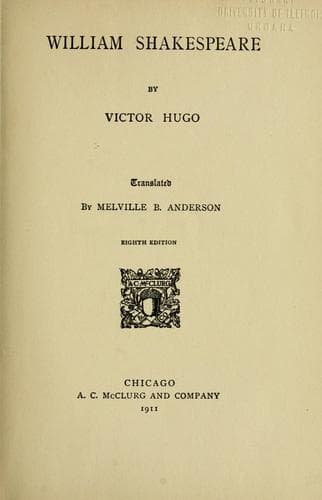
Dramatists, English -- Early modern, 1500-1700 -- Biography; Shakespeare, William, 1564-1616; Stratford-upon-Avon (England) -- Biography
In India they readily give the children into the charge of elephants.
These enormous specimens of goodness watch over the little things.
The whole group of flaxen heads sing, laugh, and play under the shade
of the trees. The habitation is at some distance. The mother is not
with them. She is at home, busy with her domestic cares; she pays
no attention to her children. Yet, joyful as they are, they are in
danger. These beautiful trees are treacherous; they hide under their
thickness thorns, claws, and teeth. There the cactus bristles up, the
lynx roams, the viper crawls. The children must not wander away; beyond
a certain limit they would be lost. Nevertheless, they run about, call
to one another, pull and entice one another away, some of them scarcely
stuttering, and quite unsteady on their little feet. At times one of
them goes too far. Then a formidable trunk is stretched out, seizes the
little one, and gently carries him home.
[Footnote 1: The Psychostasia.]
CHAPTER X.
There were some copies more or less complete of Æschylus.
Besides the copies in the colonies, which were limited to a small
number of pieces, it is certain that partial copies of the original at
Athens were made by the Alexandrian critics and scholars, who have left
us some fragments,--among others the comic fragment of "The Argians,"
the Bacchic fragment of the "Edons," the lines cited by Stobæus, and
even the probably apocryphal verses given by Justin the Martyr.
These copies, buried but perhaps not destroyed, have buoyed up the
persistent hope of searchers,--notably of Le Clerc, who published
in Holland, in 1709, the discovered fragments of Menander. Pierre
Pelhestre, of Rouen, the man who had read everything, for which the
worthy Archbishop Péréfixe scolded him, affirmed that the greater
part of the poems of Æschylus would be found in the libraries of the
monasteries of Mount Athos, just as the five books of the "Annals" of
Tacitus had been discovered in the Convent of Corwey in Germany, and
the "Institutions" of Quintilian, in an old tower of the Abbey of St.
Gall.
A tradition, not undisputed, would have it that Euergetes II. had
returned to Athens, not the original copy of Æschylus, but a copy,
leaving the fifteen talents as a compensation.
Public-domain text, read in full here on John Shaqi.
Reviews
Reviews
No reviews yet
Be the first to share your thoughts on this work.
Elsewhere in the archive
Join the Discussion
Join the discussion
Sign in to leave a comment or review.
Sign InorCreate an account