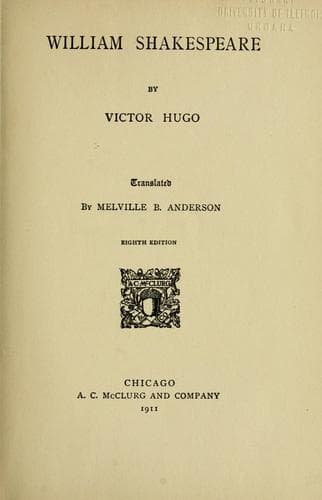
Dramatists, English -- Early modern, 1500-1700 -- Biography; Shakespeare, William, 1564-1616; Stratford-upon-Avon (England) -- Biography
He has
marked the transition of the man-slave to the free-man. Try and deprive
civilization of him, you become Egypt. The decrease of the liberty of
the press is enough to diminish the stature of a people.
One of the great features in this deliverance of man by printing,
is, let us insist on it, the indefinite preservation of poets and
philosophers. Gutenberg is like the second father of the creations of
the mind. Before him, yes, it was possible for a _chef-d'œuvre_ to die.
Greece and Rome have left--mournful thing to say--vast ruins of books.
A whole facade of the human mind half crumbled, that is antiquity. Here
the ruin of an epic poem, there a tragedy dismantled; great verses
effaced, buried, and disfigured; pediments of ideas almost entirely
fallen; geniuses truncated like columns; palaces of thought without
ceiling and door; bleached bones of poems; a death's-head which has
been a strophe; immortality in ruins. Fearful nightmare! Oblivion,
dark spider, hangs its web between the drama of Æschylus and the
history of Tacitus.
Where is Æschylus? In pieces everywhere. Æschylus is scattered in
twenty texts. His ruins must be sought in innumerable different places.
Athenæus gives the dedication "To Time," Macrobius the fragment of
"Etna" and the homage to the Palic gods, Pausanias the epitaph. The
biographer is anonymous; Goltzius and Meursius give the titles of the
lost pieces.
We know from Cicero, in the "Disputationes Tusculanæ," that Æschylus
was a Pythagorean; from Herodotus, that he fought bravely at Marathon;
from Diodorus of Sicily, that his brother Amynias behaved valiantly at
Platæa; from Justin, that his brother Cynegyrus was heroic at Salamis.
We know by the didascalies that "The Persians" were represented under
the archon Meno, "The Seven Chiefs before Thebes" under the archon
Theagenides, and the "Orestias" under the archon Philocles; we know
from Aristotle that Æschylus was the first to venture to make two
personages speak at a time on the stage; from Plato that the slaves
were present at his plays; from Horace, that he invented the mask
and the buskin; from Pollux, that pregnant women miscarried at the
appearance of his Furies; from Philostratus, that he abridged the
monodies; from Suidas, that his theatre tumbled down under the pressure
of the crowd; from Ælian, that he committed blasphemy; from Plutarch,
that he was exiled; from Valerius Maximus, that an eagle killed him by
letting a tortoise fall on his head; from Quintilian, that his plays
were re-cast; from Fabricius, that his sons are accused of this crime
of laze-paternity; from the Arundel marbles, the date of his birth, the
date of his death, and his age,--sixty-nine years.
Public-domain text, read in full here on John Shaqi.
Reviews
Reviews
No reviews yet
Be the first to share your thoughts on this work.
Elsewhere in the archive
Join the Discussion
Join the discussion
Sign in to leave a comment or review.
Sign InorCreate an account