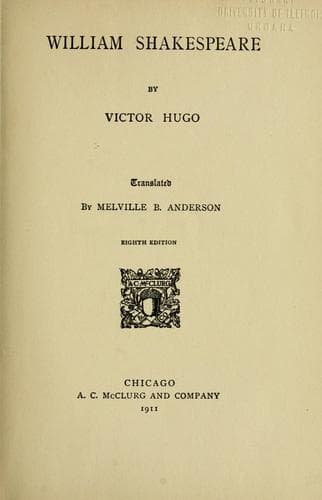
Dramatists, English -- Early modern, 1500-1700 -- Biography; Shakespeare, William, 1564-1616; Stratford-upon-Avon (England) -- Biography
Independently of the story about Euergetes and Omar that we have
related, and which, very true in the whole, is perhaps legendary
in more than one particular, the loss of so many beautiful works of
antiquity is but too well explained by the small number of copies.
Egypt, in particular, transcribed everything on papyrus. The papyrus,
being very dear, became very rare. People were reduced to write on
pottery. To break a vase was to destroy a book. About the time when
Jesus Christ was painted on the walls at Rome, with the hoofs of an
ass, and this inscription, "The God of the Christians, hoof of an ass,"
in the third century, to make ten manuscripts of Tacitus yearly,--or,
as we should say to-day, to strike off ten copies of his works,--a
Cæsar must needs call himself Tacitus, and believe Tacitus to be his
uncle. And yet Tacitus is nearly lost. Of the twenty-eight years of his
"History of the Cæsars,"--from the year 69 to the year 96,--we have
but one complete year, 69, and a fragment of the year 70. Euergetes
prohibited the exportation of papyrus, which caused parchment to be
invented. The price of papyrus was so high that Firmius the Cyclop,
manufacturer of papyrus in 270, made by his trade enough money to raise
armies, wage war against Aurelian, and declare himself emperor.
Gutenberg is a redeemer. These submersions of the works of the mind,
inevitable before the invention of printing, are impossible at present.
Printing is the discovery of the inexhaustible. It is perpetual motion
found for social science. From time to time a despot seeks to stop or
to slacken it, and he is worn away by the friction. The impossibility
to shackle thought, the impossibility to stop progress, the book
imperishable,--such is the result of printing. Before printing,
civilization was subject to losses of substance; the essential signs
of progress, proceeding from such a philosopher or such a poet, were
all at once lacking: a page was suddenly torn from the human book.
To disinherit humanity of all the great bequests of genius, the
stupidity of a copyist or the caprice of a tyrant sufficed. No such
danger in the present day. Henceforth the unseizable reigns. No one
could serve a writ upon thought and take up its body. It has no longer
a body. The manuscript was the body of the masterpiece; the manuscript
was perishable, and carried off the soul,--the work. The work, made
a printed sheet, is delivered. It is now only a soul. Kill now this
immortal! Thanks to Gutenberg, the copy is no longer exhaustible.
Every copy is a root, and has in itself its own possible regeneration
in thousands of editions; the unit is pregnant with the innumerable.
This prodigy has saved universal intelligence. Gutenberg, in the
fifteenth century, emerges from the awful obscurity, bringing out
of the darkness that ransomed captive, the human mind. Gutenberg is
forever the auxiliary of life; he is the permanent fellow-workman in
the great work of civilization. Nothing is done without him.
Public-domain text, read in full here on John Shaqi.
Reviews
Reviews
No reviews yet
Be the first to share your thoughts on this work.
Elsewhere in the archive
Join the Discussion
Join the discussion
Sign in to leave a comment or review.
Sign InorCreate an account