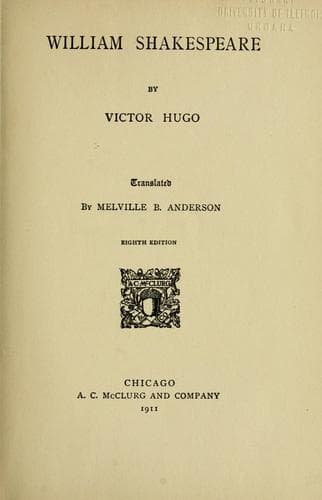
Dramatists, English -- Early modern, 1500-1700 -- Biography; Shakespeare, William, 1564-1616; Stratford-upon-Avon (England) -- Biography
Is it not fulfilled, unknown to them, by certain elects, who,
momentarily and during their earthly transit, partly ignore themselves?
Is not the function of such or such atom, divine motive power called
soul, to give movement to a solar man among earthly men? Since the
floral atom exists, why should not the stellary atom exist? That
solar man will be, in turn, the savant, the seer, the calculator, the
thaumaturge, the navigator, the architect, the magian, the legislator,
the philosopher, the prophet, the hero, the poet. The life of humanity
will move onward through them. The volutation of civilization will be
their task; that team of minds will drag the huge chariot. One being
unyoked, the others will start again. Each completion of a century
will be one stage on the journey. Never any solution of continuity.
That which one mind will begin, another mind will finish, soldering
phenomenon to phenomenon, sometimes without suspecting that welding
process. To each revolution in the fact will correspond an adequate
revolution in the ideas, and reciprocally. The horizon will not be
allowed to extend to the right without stretching as much to the
left. Men the most diverse, the most opposite, sometimes will adhere
by unexpected parts; and in these adherences will burst forth the
imperious logic of progress. Orpheus, Bouddha, Confucius, Zoroaster,
Pythagoras, Moses, Manou, Mahomet, with many more, will be the links
of the same chain. A Gutenberg discovering the method for the sowing
of civilization, and the means for the ubiquity of thought, will
be followed by a Christopher Columbus discovering a new field. A
Christopher Columbus discovering a world will be followed by a Luther
discovering a liberty. After Luther, innovator in the dogma, will come
Shakespeare, innovator in art. One genius completes the other.
But not in the same region. The astronomer follows the philosopher; the
legislator is the executor of the poet's wishes; the fighting liberator
lends his assistance to the thinking liberator; the poet corroborates
the statesman. Newton is the appendix to Bacon; Danton originates from
Diderot; Milton confirms Cromwell; Byron supports Botzaris; Æschylus,
before him, has assisted Miltiades. The work is mysterious even for
the very men who perform it. Some are conscious of it, others not. At
great distances, at intervals of centuries, the correlations manifest
themselves, wonderful. The modification in human manners, begun by the
religious revealer, will be completed by the philosophical reasoner,
so that Voltaire follows up Jesus. Their work agrees and coincides. If
this concordance rested with them, both would resist, perhaps,--the
one, the divine man, indignant in his martyrdom, the other, the human
man, humiliated in his irony; but that is so. Some one who is very high
orders it in that way.
Yes, let us meditate on these vast obscurities. The characteristic of
revery is to gaze at darkness so intently that it brings light out of
it.
Public-domain text, read in full here on John Shaqi.
Reviews
Reviews
No reviews yet
Be the first to share your thoughts on this work.
Elsewhere in the archive
Join the Discussion
Join the discussion
Sign in to leave a comment or review.
Sign InorCreate an account