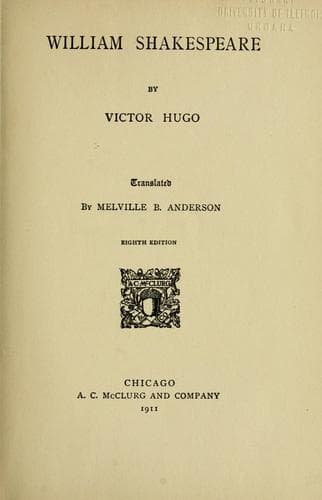
Dramatists, English -- Early modern, 1500-1700 -- Biography; Shakespeare, William, 1564-1616; Stratford-upon-Avon (England) -- Biography
Humanity developing itself from the interior to the exterior is,
properly speaking, civilization. Human intelligence becomes radiance,
and step by step, wins, conquers, and humanizes matter. Sublime
domestication! This labour has phases; and each of these phases,
marking an age in progress, is opened or closed by one of those beings
called geniuses. These missionary spirits, these legates of God, do
they not carry in them a sort of partial solution of this question,
so abstruse, of free will? The apostolate, being an act of will, is
related on one side to liberty, and on the other, being a mission, is
related by predestination to fatality. The voluntary necessary. Such is
the Messiah; such is Genius.
Now let us return,--for all questions which append to mystery form
the circle, and one cannot get out of it,--let us return to our
starting-point, and to our first question: What is a genius? Is it not
perchance a cosmic soul, a soul imbued with a ray from the unknown? In
what depths are such souls prepared? How long do they wait? What medium
do they traverse? What is the germination which precedes the hatching?
What is the mystery of the ante-birth? Where was this atom? It seems as
if it was the point of intersection of all the forces. How come all the
powers to converge and tie themselves into an indivisible unity in this
sovereign intelligence? Who has bred this eagle? The incubation of the
fathomless on genius, what an enigma! These lofty souls, momentarily
belonging to earth, have they not seen something else? Is it for that
reason that they arrive here with so many intuitions? Some of them seem
full of the dream of a previous world. Is it thence that comes to them
the scared wildness that they sometimes have? Is it that which inspires
them with wonderful words? Is it that which gives them strange
agitations? Is it thence that they derive the hallucination which makes
them, so to speak, see and touch imaginary things and beings? Moses
had his fiery thicket; Socrates his familiar demon; Mahomet his dove;
Luther his goblin playing with his pen, and to whom he would say, "Be
still, there!" Pascal his gaping chasm that he hid with a screen.
Public-domain text, read in full here on John Shaqi.
Reviews
Reviews
No reviews yet
Be the first to share your thoughts on this work.
Elsewhere in the archive
Join the Discussion
Join the discussion
Sign in to leave a comment or review.
Sign InorCreate an account