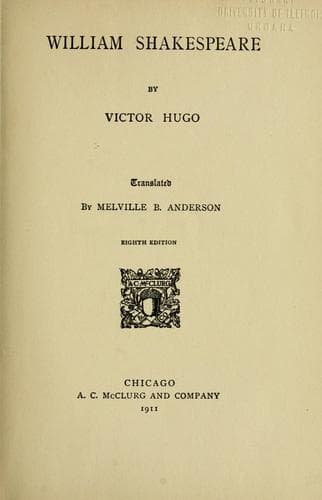
Dramatists, English -- Early modern, 1500-1700 -- Biography; Shakespeare, William, 1564-1616; Stratford-upon-Avon (England) -- Biography
Phidias created does not stop you from making Michael Angelo. Michael
Angelo completed, there still remains to thee the material for
Rembrandt. A Dante does not tire thee. Thou art no more exhausted
by a Homer than by a star. The auroras by the side of auroras, the
indefinite renewing of meteors, the worlds above the worlds, the
wonderful passage of these incandescent stars called comets, the
geniuses and again the geniuses, Orpheus, then Moses, then Isaiah, then
Æschylus, then Lucretius, then Tacitus, then Juvenal, then Cervantes
and Rabelais, then Shakespeare, then Molière, then Voltaire, those who
have been and those who will be,--that does not weary thee. Swarm of
constellations! there is room in thy immensity.
PART II.-BOOK I.
SHAKESPEARE.--HIS GENIUS.
CHAPTER I.
"Shakespeare," says Forbes, "had neither the tragic talent nor the
comic talent. His tragedy is artificial, and his comedy is but
instinctive." Johnson confirms the verdict: "His tragedy is the result
of industry, and his comedy the result of instinct." After Forbes and
Johnson had contested his claim to drama, Green contested his claim
to originality. Shakespeare is "a plagiarist;" Shakespeare is "a
copyist;" Shakespeare "has invented nothing;" he is "a crow adorned
with the plumes of others;" he pilfers Æschylus, Boccaccio, Bandello,
Holinshed, Belleforest, Benoist de St. Maur; he pilfers Layamon, Robert
of Gloucester, Robert of Wace, Peter of Langtoft, Robert Manning,
John de Mandeville, Sackville, Spenser; he steals the "Arcadia" of
Sidney; he steals the anonymous work called the "True Chronicle of King
Leir;" he steals from Rowley in "The Troublesome Reign of King John"
(1591), the character of the bastard Faulconbridge. Shakespeare pilfers
Thomas Greene; Shakespeare pilfers Dekker and Chettle. Hamlet is not
his;--Othello is not his; Timon of Athens is not his, nothing is
his. As for Green, Shakespeare is for him not only "a blower of blank
verses," a "shakescene," a _Johannes factotum_ (allusion to his former
position as call-boy and supernumerary); Shakespeare is a wild beast.
Crow no longer suffices; Shakespeare is promoted to a tiger. Here is
the text: "Tyger's heart wrapt in a player's hyde."[1]
Thomas Rhymer judges "Othello:"--
"The moral of this story is certainly very instructive. It
is a warning to good housewives to look after their linen."
Then the same Rhymer condescends to give up joking, and to take
Shakespeare in earnest:--
"What edifying and useful impression can the audience
receive from such poetry? To what can this poetry serve,
unless it is to mislead our good sense, to throw our
thoughts into disorder, to trouble our brain, to pervert our
instincts, to crack our imaginations, to corrupt our taste,
and to fill our heads with vanity, confusion, clatter, and
nonsense?"
This was printed eighty years after the death of Shakespeare, in 1693.
All the critics and all the connoisseurs were of one opinion.
Public-domain text, read in full here on John Shaqi.
Reviews
Reviews
No reviews yet
Be the first to share your thoughts on this work.
Elsewhere in the archive
Join the Discussion
Join the discussion
Sign in to leave a comment or review.
Sign InorCreate an account