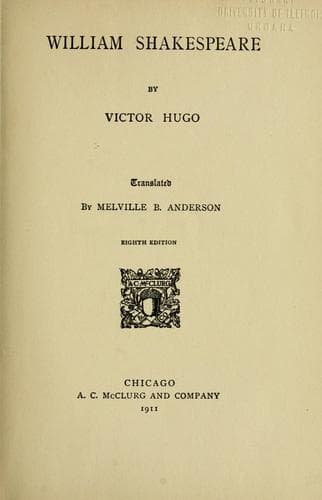
Dramatists, English -- Early modern, 1500-1700 -- Biography; Shakespeare, William, 1564-1616; Stratford-upon-Avon (England) -- Biography
Here are some of the reproaches unanimously addressed to Shakespeare:
Conceits, play on words, puns; improbability, extravagance, absurdity;
obscenity; puerility; bombast; emphasis, exaggeration; false glitter,
pathos; far-fetched ideas, affected style; abuse of contrast and
metaphor; subtilty; immorality; writing for the mob; pandering to the
_canaille_; delighting in the horrible; want of grace; want of charm;
overreaching his aim; having too much wit; having no wit; overdoing his
works.
"This Shakespeare is a coarse and savage mind," says Lord Shaftesbury.
Dryden adds, "Shakespeare is unintelligible." Mrs. Lennox gives
Shakespeare this slap: "This poet alters historical truth." A German
critic of 1680, Bentheim, feels himself disarmed, because, says he,
"Shakespeare is a mind full of drollery." Ben Jonson, Shakespeare's
protégé, relates this. "I recollect that the comedians mentioned to the
honour of Shakespeare, that in his writings he never erased a line.
I answered, 'Would to God he had erased a thousand.'"[2] This wish,
moreover, was granted by the worthy publishers of 1623,--Blount and
Jaggard. They struck out of Hamlet alone two hundred lines; they cut
out two hundred and twenty lines of "King Lear." Garrick played at
Drury Lane only the "King Lear" of Nahum Tate. Listen again to Rhymer:
"'Othello' is a sanguinary farce without wit." Johnson adds, "'Julius
Cæsar,' a cold tragedy, and lacking the power to move the public."
"I think," says Warburton, in a letter to the Dean of St. Asaph,
"that Swift has much more wit than Shakespeare, and that the comic in
Shakespeare, altogether low as it is, is very inferior to the comic
in Shadwell." As for the witches in "Macbeth," "Nothing equals," says
that critic of the seventeenth century, Forbes, repeated by a critic of
the nineteenth, "the absurdity of such a spectacle." Samuel Foote, the
author of the "Young Hypocrite," makes this declaration: "The comic in
Shakespeare is too heavy, and does not make one laugh. It is buffoonery
without wit." At last, Pope, in 1725, finds a reason why Shakespeare
wrote his dramas, and exclaims, "One must eat!"
After these words of Pope, one cannot understand with what object
Voltaire, aghast about Shakespeare, writes: "Shakespeare whom the
English take for a Sophocles, flourished about the time of Lopez
[Lope, if you please, Voltaire] de Vega." Voltaire adds, "You are not
ignorant that in 'Hamlet' the diggers prepare a grave, drinking,
singing ballads, and cracking over the heads of dead people the jokes
usual to men of their profession." And, concluding, he qualifies thus
the whole scene,--"these follies." He characterizes Shakespeare's
pieces by this word, "monstrous farces called tragedies," and completes
the judgment by declaring that Shakespeare "has ruined the English
theatre."
Public-domain text, read in full here on John Shaqi.
Reviews
Reviews
No reviews yet
Be the first to share your thoughts on this work.
Elsewhere in the archive
Join the Discussion
Join the discussion
Sign in to leave a comment or review.
Sign InorCreate an account