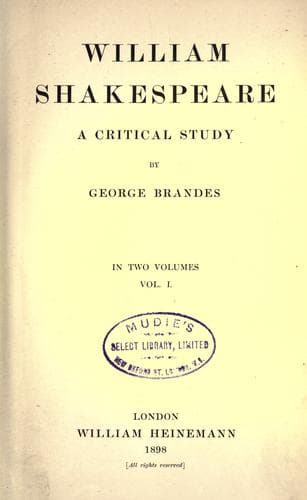
William Shakespeare: A Critical StudyBrandes, Georg
General
William Shakespeare: A Critical Study
Brandes, Georg
Shakespeare, William, 1564-1616 -- Criticism and interpretation
For the young noblemen among the audience, again, nothing could be more
attractive than to see this great King, in his youth, haunting such
resorts as they themselves frequented, and yet, as the best of them
also tried to do, preserving the consciousness of his high dignity, the
hope of a great future, and the determination to achieve renown, even
while associating with Falstaff and Bardolph, Dame Quickly and Doll
Tearsheet.
These young English aristocrats, who in Shakespeare appear under the
names of Mercutio and Benedick, Gratiano and Lorenzo, made pleasure
their pursuit through the whole of the London day. Dressed in silk or
ash-coloured velvet, and with gold lace on his cloak, the young man
of fashion began by riding to St. Paul's and promenading half-a-dozen
times up and down its middle aisle. He then "repaired to the Exchange,
and talked pretty Euphuisms to the citizens' daughters," or looked in
at the bookseller's to inspect the latest play-book or pamphlet against
tobacco. Next he rode to the ordinary where he had appointed to meet
his friends and dine. At dinner he discussed Drake's expedition to
Portugal, or Essex's exploits at Cadiz, or told how he had yesterday
broken a lance with Raleigh himself at the Tilt-yard. He would mingle
snatches of Italian and Spanish with his talk, and let himself be
persuaded after dinner, to recite a sonnet of his own composition. At
three he betook himself to the theatre, saw Burbage as Richard III.,
and applauded Kemp in his new jig; after which he would spend an hour
at the bear-garden. Then to the barber's, to have his hair and beard
trimmed, in preparation for the carouse of the evening at whichever
tavern he and his friends had selected--the "Mitre," the "Falcon," the
"Apollo," the "Boar's Head," the "Devil," or (most famous of all) the
"Mermaid," where the literary club, the Syren, founded by none other
than Sir Walter Raleigh himself, held its meetings.[2] In these places
the young aristocrat rubbed shoulders with the leading players, such as
Burbage and Kemp, and with the best-known men of letters, such as John
Lyly, George Chapman, John Florio, Michael Drayton, Samuel Daniel, John
Marston, Thomas Nash, Ben Jonson, William Shakespeare.
Public-domain text, read in full here on John Shaqi.
Reviews
Reviews
No reviews yet
Be the first to share your thoughts on this work.
Elsewhere in the archive
Join the Discussion
Join the discussion
Sign in to leave a comment or review.
Sign InorCreate an account