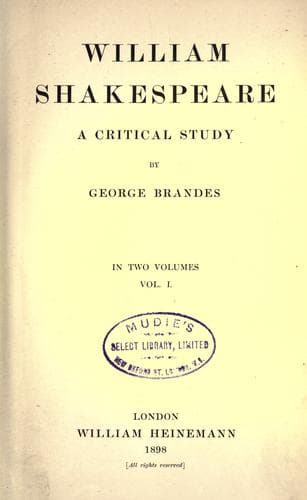
William Shakespeare: A Critical StudyBrandes, Georg
General
William Shakespeare: A Critical Study
Brandes, Georg
Shakespeare, William, 1564-1616 -- Criticism and interpretation
Shakespeare finds the matter for these plays in Holinshed's Chronicle,
and in an old, quite puerile play, _The Famous Victories of Henry the
fifth, conteining the Honorable Battell of Agin-court,_ in which the
young Prince is represented as frequenting the company of roisterers
and highway robbers. It was this, no doubt, that suggested to him
the novel and daring idea of transferring direct to the stage, in
historical guise, a series of scenes from the everyday life of the
streets and taverns around him, and blending them with the dramatised
chronicle of the Prince whom he regarded as the national hero of
England. To this blending we owe the matchless freshness of the whole
picture.
For the rest, Shakespeare found scarcely anything in the foolish old
play, acted between 1580 and 1588, which could in any way serve his
purpose. He took from it only the anecdote of the box on the ear given
by the Prince of Wales to the Lord Chief-Justice, and a few names--the
tavern in Eastcheap, Gadshill, Ned, and the name, not the character, of
Sir John Oldcastle, as Falstaff was originally called.
Shakespeare felt himself attracted to the hero, the young Prince, by
some of the most deep-rooted sympathies of his nature. We have seen
how vividly and persistently the contrast between appearance and
reality preoccupied him; we saw it last in _The Merchant of Venice_.
In proportion as he was irritated and repelled by people who try to
pass for more than they are, by creatures of affectation and show,
even by women who resort to artificial colours and false hair in quest
of a beauty not their own, so his heart beat warmly for any one who
had appearances against him, and concealed great qualities behind an
unassuming and misinterpreted exterior. His whole life, indeed, was
just such a paradox--his soul was replete with the greatest treasures,
with rich humanity and inexhaustible genius, while externally he was
little better than a light-minded mountebank, touting, with quips and
quiddities, for the ha'pence of the mob. Now and then, as his Sonnets
show, the pressure of this outward prejudice so weighed upon him that
he came near to being ashamed of his position in life, and of the
tinsel world in which his days were passed; and then he felt with
double force the inward need to assure himself how great may be the
gulf between the apparent and the real worth of human character.
Moreover, this view of his material gave him an occasion, before
tuning the heroic string of his lyre, to put in a word for the right
of high-spirited youth to have its fling, and indirectly to protest
against the hasty judgments of narrow-minded moralists and Puritans.
He would here show that great ambitions and heroic energy could
pass unscathed through the dangers even of exceedingly questionable
diversions. This Prince of Wales was "merry England" and "martial
England" in one and the same person.
Public-domain text, read in full here on John Shaqi.
Reviews
Reviews
No reviews yet
Be the first to share your thoughts on this work.
Elsewhere in the archive
Join the Discussion
Join the discussion
Sign in to leave a comment or review.
Sign InorCreate an account