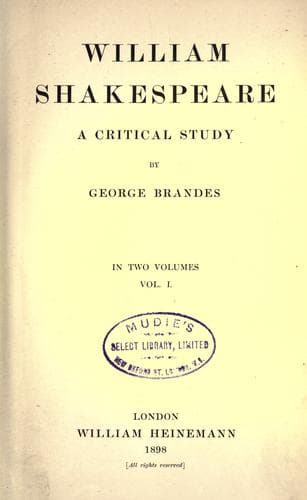
William Shakespeare: A Critical StudyBrandes, Georg
General
William Shakespeare: A Critical Study
Brandes, Georg
Shakespeare, William, 1564-1616 -- Criticism and interpretation
"Which two I behold like a _Spanish great Gallion_ and an
_English man of War_: Master _Johnson_ (like the former) was
built far higher in Learning; _Solid_, but _Slow_ in his
performances. _Shake-spear_, with the _English man of War_,
lesser in _bulk_, but lighter in _sailing_, could turn with
all tides, tack about, and take advantage of all winds, by
the quickness of his Wit and Invention."
Although Fuller was not himself present at these symposia, yet his
account of them bears the stamp of complete authenticity.
Among the members of the circle which Shakespeare in his youth
frequented, there must, of course, have been types of every kind, from
the genius down to the grotesque; and there were some, no doubt, in
whom the genius and the grotesque, the wit and the butt, must have
quaintly intermingled. As every great household had at that time its
_jester_, so every convivial circle had its clown or buffoon. The
jester was the terror of the kitchen--for he would steal a pudding the
moment the cook's back was turned--and the delight of the dinner-table,
where he would mimic voices, crack jokes, play pranks, and dissipate
the spleen of the noble company. The comic man of the tavern circle
was both witty himself and the cause of wit in others. He was always
the butt of the others' merriment, yet he always held his own in the
contest, and ended by getting the best of his tormentors.
To Shakespeare's circle Chettle must doubtless have belonged, that
Chettle who in bygone days had published Greene's _Groats-worth of
Wit_, and afterwards made amends to Shakespeare for Greene's coarse
attack upon him. In Dekker's tract, _A Knights Conjuring_, dating from
1607, he figures among the poets in Elysium, where he is introduced in
the following terms:--"In comes Chettle sweating and blowing, by reason
of his fatnes; to welcome whom, because hee was of olde acquaintance,
all rose vp, and fell presentlie on their knees, to drinck a health
to all the louers of Hellicon." Elze has conjectured, possibly with
justice, that in this puffing and sweating old tun of flesh, who is
so whimsically greeted with mock reverence by the whole gay company,
we have the very model from whom Shakespeare drew his demigod, the
immortal Sir John Falstaff, beyond comparison the gayest, most
concrete, and most entertaining figure in European comedy.
In his close-woven and unflagging mirthfulness, in the inexhaustible
wealth of drollery concentrated in his person, Falstaff surpasses all
that antiquity and the Middle Ages have produced in the way of comic
character, and all that the stage of later times can show.
Public-domain text, read in full here on John Shaqi.
Reviews
Reviews
No reviews yet
Be the first to share your thoughts on this work.
Elsewhere in the archive
Join the Discussion
Join the discussion
Sign in to leave a comment or review.
Sign InorCreate an account