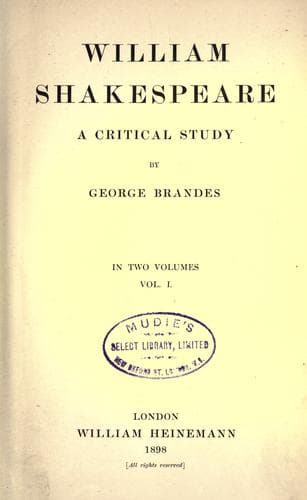
William Shakespeare: A Critical StudyBrandes, Georg
General
William Shakespeare: A Critical Study
Brandes, Georg
Shakespeare, William, 1564-1616 -- Criticism and interpretation
There is in him something of the old Greek Silenus, swag-bellied and
infinitely jovial, and something of the _Vidushakas_ of the old Indian
drama, half court-fool, half friend and comrade to the hero. He unites
in himself the two comic types of the old Roman comedy, Artotrogus and
Pyrgopolinices, the parasite and the boastful soldier. Like the Roman
_scurra_, he leaves his patron to pay the reckoning, and in return
entertains him with his jests, and, like the _Miles Gloriosus_, he is
a braggart above all braggarts, a liar above all liars. Yet he is in
his single person richer and more entertaining than all the ancient
Silenuses and court-fools and braggarts and parasites put together.
In the century after he came into existence, Spain and France each
developed its own theatre. In France there is only one quaint and
amusing person, Moron in Molière's _La Princesse d'Élide_, who bears
some faint resemblance to Falstaff. In Spain, where the great and
delightful character of Sancho Panza affords the starting-point for the
whole series of comic figures in the works of Calderon, the _Gracioso_
stands in perpetual contrast to the hero, and here and there reminds
us for a moment of Falstaff, but always only as an abstraction of one
side or another of his nature, or because of some external similarity
of situation. In _La Dama Duende_ he is a drunkard and coward; in _La
Gran Cenobia_ he boasts fantastically, and, like Falstaff, becomes
entangled in his lies. In _La Puente de Mantible_ he actually becomes
(as it appears from the scenes with the Chief Justice and Colevile that
Falstaff also was) renowned and dreaded for his military valour; yet
he is, like Falstaff, extremely ill at ease when there is any fighting
to be done, often creeping into cover, hiding himself behind a bush,
or climbing a tree. In _La Hija del Ayre_ and _El Principe Constante_
he uses precisely the device adopted by Falstaff and certain lower
animals, of lying down and shamming death. Hernando in _Los Empeῆos de
un Acaso_ (like Molière's Moron) expresses sentiments very similar to
those of Falstaff in his celebrated discourse upon honour. Falstaff's
airs of protection, his bland fatherliness, we find in Fabio in _El
Secreto a Voces._ Thus single characteristics, detached sides of
Falstaff's character, have to do duty as complete personages. Calderon
as a rule looks with fatherly benevolence upon his Gracioso. Yet he
sometimes loses patience, as it were, with his buffoon's epicurean,
unchristian, and unchivalrous view of life. In _La Vida es Sueño_, for
instance, a cannon-ball kills poor Clarin, who has crept behind a bush
during the battle; the moral being that the coward does not escape
danger any more than the brave man. Calderon bestows on him a very
solemn funeral speech, almost as moral as King Henry's parting words to
Falstaff.
Public-domain text, read in full here on John Shaqi.
Reviews
Reviews
No reviews yet
Be the first to share your thoughts on this work.
Elsewhere in the archive
Join the Discussion
Join the discussion
Sign in to leave a comment or review.
Sign InorCreate an account