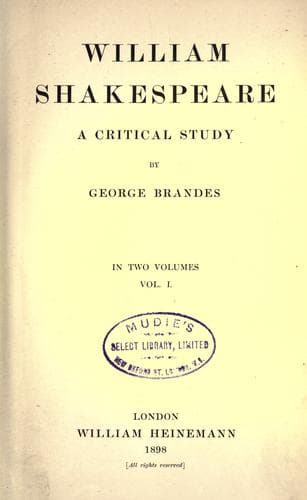
William Shakespeare: A Critical StudyBrandes, Georg
General
William Shakespeare: A Critical Study
Brandes, Georg
Shakespeare, William, 1564-1616 -- Criticism and interpretation
[1] It was this characteristic of Shakespeare's style, at the
period we are now considering, that so deeply influenced Goethe and the
contemporaries of his youth, Lenz and Klinger (and, in Denmark, Hauch
and Bredahl), determining the diction of their tragic dramas. Björnson
shows traces of the same influence in his _Maria Stuart_ and _Sigurd
Slembe._
[2] Thornbury: _Shakspere's England_, i. 104, _et seq_.
[3] _Fresh Allusions to Shakespeare_, p. 372.
[4] Thornbury: _Shakspere's England_, i. 227; Nathan Drake,
_Shakespeare and His Times_, ii. 131.
[5] Jeppe paa Bjerget, a Danish Abou Hassan or Christopher
Sly, is the hero of one of Holberg's most admirable comedies.
[6] Maurice Morgann: _An Essay on the Dramatic Character of
Sir John Falstaff,_ p. 150.
[7] From a poem by Tegnér on Bellman, the Swedish convivial
lyrist.
XXIII
_HENRY PERCY--THE MASTERY OF THE CHARACTER-DRAWING--HOTSPUR AND
ACHILLES_
In contrast to Falstaff, Shakespeare has placed the man whom his ally
Douglas expressly calls "the king of honour"--a figure as firmly
moulded and as great as the Achilles of the Greeks or Donatello's
Italian St. George--"the Hotspur of the North," an English national
hero quite as much as the young Prince.
The chronicle and the ballad of Douglas and Percy gave Shakespeare no
more than the name and the dates of a couple of battles. He seized upon
the name Harry Percy, and although its bearer was not historically of
the same age as Prince Henry, but as old as his father, the King, he
docked him of a score of years, with the poetical design of opposing
to the hero of the play a rival who should be his peer, and should at
first seem to outshine him.
Percy is above everything and every one avid of honour. It is he who
would have found it easy to pluck down honour from the moon or drag it
up from the depths of the sea. But he is of an open, confiding, simple
nature, with nothing of the diplomatist about him. He is hasty and
impetuous; his spur is never cold until he is dead. Under the mistaken
impression that women cannot keep their counsel, he is reticent towards
his wife, in whom he might quite well confide, since she adores him,
and calls him "the miracle of men." On the other hand, he suffers
himself to be driven by the King's sour suspiciousness into foolhardy
rebellion, and he is so simple-minded as to trust to his father and his
uncle Worcester, one of whom deserts him in the hour of need, while the
other plays a double game with him.
Shakespeare has thrown himself so passionately into the creation of
this character that he has actually painted for us Hotspur's exterior,
giving him a peculiar walk and manner of speech. The warmth of the
poet's sympathy has rendered his hero irresistibly attractive, and made
him, in his manliness, a pattern for the youth of the whole country.
Henry Percy enters (ii. 3) with a letter in his hand, and reads:--
Public-domain text, read in full here on John Shaqi.
Reviews
Reviews
No reviews yet
Be the first to share your thoughts on this work.
Elsewhere in the archive
Join the Discussion
Join the discussion
Sign in to leave a comment or review.
Sign InorCreate an account