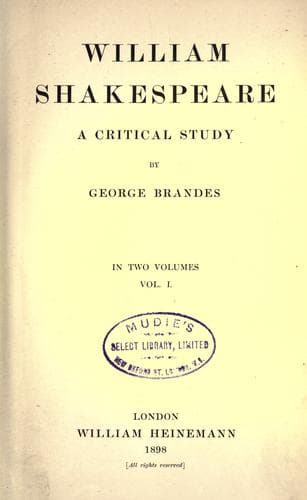
William Shakespeare: A Critical StudyBrandes, Georg
General
William Shakespeare: A Critical Study
Brandes, Georg
Shakespeare, William, 1564-1616 -- Criticism and interpretation
But here, in the First Part, Falstaff is still a demi-god, supreme
alike in intellect and in wit. With this figure the popular drama which
Shakespeare represented won its first decisive battle over the literary
drama which followed in the footsteps of Seneca. We can actually hear
the laughter of the "yard" and the gallery surging around his speeches
like waves around a boat at sea. It was the old sketch of Parolles
in _Love's Labour's Won_ (see above, p. 49), which had here taken on
a new amplitude of flesh and blood. There was much to delight the
groundlings--Falstaff is so fat and yet so mercurial, so old and yet so
youthful in all his tastes and vices. But there was far more to delight
the spectators of higher culture, in his marvellous quickness of fence,
which can parry every thrust, and in the readiness which never leaves
him tongue-tied, or allows him to confess himself beaten. Yes, there
was something for every class of spectators in this mountain of flesh,
exuding wit at every pore, in this hero without shame or conscience,
in this robber, poltroon, and liar, whose mendacity is quite poetic,
Münchausenesque, in this cynic with the brazen forehead and a tongue as
supple as a Toledo blade. His talk is like Bellman's[7] after him:--
"A dance of all the gods upon Olympus,
With fauns and graces and the muses twined."
The men of the Renaissance revelled in his wit, much as the men of the
Middle Ages had enjoyed the popular legends of Reinecke Fuchs and his
rogueries.
Falstaff reaches his highest point of wit and drollery in that
typical soliloquy on honour, in which he indulges on the battlefield
of Shrewsbury (I. _Henry IV_., v. I), a soliloquy which almost
categorically sums him up, in contradistinction to the other leading
personages. For all the characters here stand in a certain relation to
the idea of honour--the King, to whom honour means dignity; Hotspur,
to whom it means the halo of renown; the Prince, who loves it as the
opposite of outward show; and Falstaff, who, in his passionate appetite
for the material good things of life, rises entirely superior to it and
shows its nothingness:--
"Honour pricks me on. Yea, but how if honour prick me off when I come
on? how then? Can honour set to a leg? No. Or an arm? No. Or take
away the grief of a wound? No. Honour hath no skill in surgery then?
No. What is honour? A word. What is that word honour? Air. A trim
reckoning!--Who hath it? He that died o' Wednesday. Doth he feel it?
No. Doth he hear it? No. Is it insensible then? Yea, to the dead. But
will it not live with the living? No. Why? Detraction will not suffer
it.--Therefore, I'll none of it: honour is a mere scutcheon; and so
ends my catechism."
Falstaff will be no slave to honour; he will rather do without it
altogether. He demonstrates in practice how a man can live without it,
and we do not miss it in him, so perfect is he in his way.
Public-domain text, read in full here on John Shaqi.
Reviews
Reviews
No reviews yet
Be the first to share your thoughts on this work.
Elsewhere in the archive
Join the Discussion
Join the discussion
Sign in to leave a comment or review.
Sign InorCreate an account