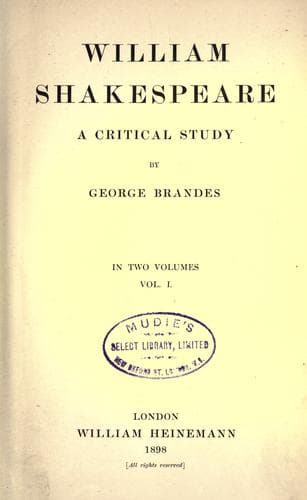
William Shakespeare: A Critical StudyBrandes, Georg
General
William Shakespeare: A Critical Study
Brandes, Georg
Shakespeare, William, 1564-1616 -- Criticism and interpretation
With such solicitude, with such minute attention to tricks, flaws,
whims, humours, and habits, all deduced from his temperament, from the
rapid flow of his blood, from his build of body, and from his life
on horseback and in the field, has Shakespeare executed this heroic
character. Restless gait, stammering speech, forgetfulness, absence
of mind, he overlooks nothing as being too trivial. Hotspur portrays
himself in every phrase he utters, without ever saying a word directly
about himself; and behind his outward, superficial peculiarities, we
see into the deeper and more significant characteristics from which they
spring. These, too, are closely interwoven; these, too, reveal
themselves in his lightest words. We hear this same hero whom pride,
sense of honour, spirit of independence, and intrepidity inspire with
the sublimest utterances, at other times chatting, jesting, and even
talking nonsense. The jests and nonsense are an integral part of the
real human being; in them, too, one side of his nature reveals itself
(iii. I):--
"_Hotspur_. Come, Kate, I'll have your song too.
_Lady Percy_. Not mine, in good sooth.
_Hot_. Not yours, in good sooth! 'Heart! you swear like a
comfit-maker's wife. 'Not you, in good sooth;' and, 'As true
as I live;' and, 'As God shall mend me;' and, 'As sure as
day:'
. . . . . . . . . .
Swear me, Kate, like a lady as thou art,
A good mouth-filling oath; and leave 'in sooth,'
And such protest of pepper-gingerbread,
To velvet-guards, and Sunday-citizens."
In a classical tragedy, French, German, or Danish, the hero is too
solemn to talk nonsense and too lifeless to jest.
In spite of his soaring energy and ambition, Hotspur is sober,
rationalistic, sceptical. He scoffs at Glendower's belief in spirits
and pretended power of conjuring them up (iii. I). His is to the inmost
fibre a truth-loving nature:--
"_Glend_. I can call spirits from the vasty deep.
_Hot_. Why, so can I, or so can any man;
But will they come, when you do call for them?
_Glend_. Why, I can teach you, cousin, to command the devil.
_Hot_. And I can teach thee, coz, to shame the devil,
By telling truth: tell truth, and shame the devil."
There is a militant rationalism in these words which was rare, very
rare, in Shakespeare's time, to say nothing of Hotspur's own.
Public-domain text, read in full here on John Shaqi.
Reviews
Reviews
No reviews yet
Be the first to share your thoughts on this work.
Elsewhere in the archive
Join the Discussion
Join the discussion
Sign in to leave a comment or review.
Sign InorCreate an account