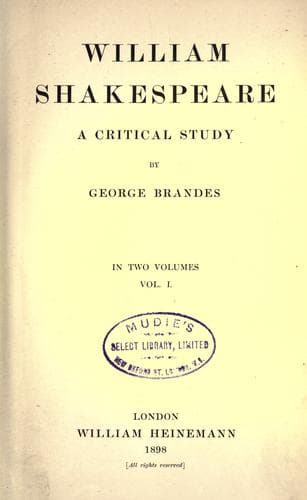
William Shakespeare: A Critical StudyBrandes, Georg
General
William Shakespeare: A Critical Study
Brandes, Georg
Shakespeare, William, 1564-1616 -- Criticism and interpretation
He has also, no doubt, the defects of his qualities. He is contentious,
quarrels the moment he is thwarted over the division of booty that has
yet to be won, and then, having gained his point, gives up his share
in the spoils. He is jealous in his ambition, cannot bear to hear any
one else praised, and would like to see Harry of Monmouth poisoned
with a pot of ale, so tired is he of hearing him spoken of. He judges
hastily, according to appearances; he has the profoundest contempt for
the Prince of Wales on account of the levity of his life, and does not
divine what lies behind it. He of course lacks all æsthetic faculty.
He is a bad speaker, and sentiment is as foreign to him as eloquence.
He prefers his dog's howling to music, and declares that the turning
of brass candlesticks does not set his teeth on edge so much as the
rhyming of balladmongers.
Yet, with all his faults, he is the greatest figure of his time. Even
the King, his enemy, becomes a poet when he speaks of him (iii. 2):--
"Thrice hath this Hotspur, Mars in swathing-clothes,
This infant warrior, in his enterprises
Discomfited great Douglas: ta'en him once,
Enlarged him, and made a friend of him."
The King longs daily that he could exchange his son for
Northumberland's; Hotspur is worthier than Prince Henry to be heir to
the throne of England.
From first to last, from top to toe, Hotspur is the hero of the
feudal ages, indifferent to culture and polish, faithful to his
brother-in-arms to the point of risking everything for his sake, caring
neither for state, king, nor commons; a rebel, not for the sake of any
political idea, but because independence is all in all to him; a proud,
self-reliant, unscrupulous vassal, who, himself a sort of sub-king,
has deposed one king, and wants to depose the usurper he has exalted,
because he has not kept his promises. Clothed in renown, and ever more
insatiate of military honour, he is proud from independence of spirit
and truthful out of pride. He is a marvellous figure as Shakespeare has
projected him, stammering, absent, turbulent, witty, now simple, now
magniloquent. His hauberk clatters on his breast, his spurs jingle at
his heel, wit flashes from his lips, while he moves and has his being
in a golden nimbus of renown.
Individual as he is, Shakespeare has embodied in him the national type.
From the crown of his head to the sole of his foot, Hotspur is an
Englishman. He unites the national impetuosity and bravery with sound
understanding; he is English in his ungallant but cordial relation
to his wife; in the form, of his chivalry, which is Northern, not
Romanesque; in his Viking-like love of battle for battle's and honour's
sake, apart from any sentimental desire for a fair lady's applause.
Public-domain text, read in full here on John Shaqi.
Reviews
Reviews
No reviews yet
Be the first to share your thoughts on this work.
Elsewhere in the archive
Join the Discussion
Join the discussion
Sign in to leave a comment or review.
Sign InorCreate an account