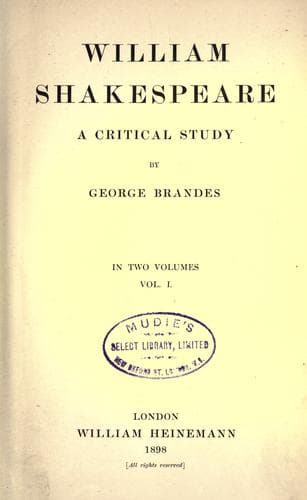
William Shakespeare: A Critical StudyBrandes, Georg
General
William Shakespeare: A Critical Study
Brandes, Georg
Shakespeare, William, 1564-1616 -- Criticism and interpretation
How strongly Shakespeare was impressed by the greatness of his theme
appears in his reiterated expressions of humility in approaching it.
He begins, like the epic poets of antiquity, with an invocation of
the Muse; he implores forgiveness, not only for the imperfection of
his scenic apparatus, but for the "flat unraised spirits" in which he
treats so mighty a theme. And in the prologue to the fourth act he
returns to the subject of his unworthiness and the pitiful limitations
of the stage. Throughout the choruses, he has done his utmost, by
dint of vivid imagery and lyric impetus and splendour, to make up for
the sacrifice of unity and cohesion involved in his faithfulness to
history. Shakespeare was evidently unconscious of the naïveté of the
lecture on the Salic law, establishing Henry's claim to the crown of
France, with which the Archbishop opens the play; no doubt he thought
it absolutely imposed upon him.
For he here strives to make Henry an epitome of all the virtues he
himself most highly values. Even in the last act of the Second Part
of _Henry IV._ he had endowed him with traits of irreproachable
kingly magnanimity. Henry confirms in his office the Chief-Justice,
who, in the execution of his duty, had arrested the Prince of Wales,
addresses him with the deepest respect, and even calls him "father."
In reality this Chief-Justice was dismissed at the King's accession.
_Henry V._ completes the evolution of the royal butterfly from
the larva and chrysalis stages of the earlier plays. Henry is at
once the monarch who always thinks royally, and never forgets his
pride as the representative of the English people; the man with no
pose or arrogance, who bears himself simply, talks modestly, acts
energetically, and thinks piously; the soldier who endures privations
like the meanest of his followers, is downright in his jesting and
his wooing, and enforces discipline with uncompromising strictness,
even as against his own old comrades; and finally, the citizen who
is accessible alike to small and great, and in whom the youthful
frolicsomeness of earlier days has become the humourist's relish for
a practical joke, like that which he plays off upon Williams and
Fluellen. Shakespeare shows him, like a military Haroun Al Raschid,
seeking personally to insinuate himself into the thoughts and feelings
of his followers; and--what is very unlike him--he manifests no
disapproval where the King sinks far below the ideal, as when he orders
the frightful massacre of all the French prisoners taken at Agincourt.
Shakespeare tries to pass the deed off as a measure of necessity.
Public-domain text, read in full here on John Shaqi.
Reviews
Reviews
No reviews yet
Be the first to share your thoughts on this work.
Elsewhere in the archive
Join the Discussion
Join the discussion
Sign in to leave a comment or review.
Sign InorCreate an account