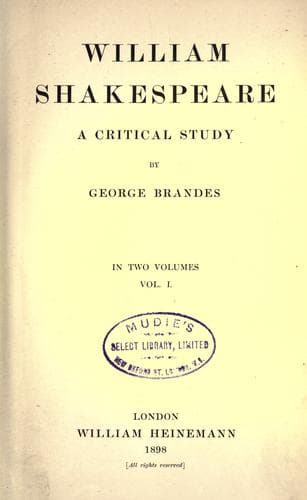
William Shakespeare: A Critical StudyBrandes, Georg
General
William Shakespeare: A Critical Study
Brandes, Georg
Shakespeare, William, 1564-1616 -- Criticism and interpretation
Throughout this Second Part, the King, besieged by cares and living in
the shadow of death, is richer in thought and wisdom than ever before.
What he says, and what is said to him, seems drawn by the poet from the
very depths of his own experience, and addressed to men of the like
experience and thought. Every word of that first scene of the third act
is in the highest degree significant and admirable. It is here that
the King turns to what we now call geology (see above, p. 95) for an
image of the historical mutability of all things. When he mournfully
reminds his attendants that Richard II., whom he displaced, prophesied
a Nemesis to come from those who had helped him to the throne, and that
this Nemesis has now over-taken him, Warwick answers with the profound
and astonishingly modern reflection that history is apparently governed
by laws, and that each man's life--
"Figures the nature of the times deceas'd;
The which observ'd, a man may prophesy,
With a near aim, of the main chance of things
As yet not come to life."
To this the King returns the no less philosophical answer:--
"Are these things, then, necessities?
Then let us meet them like necessities."
But it is at the close of the fourth act, where news of the total
defeat of the rebels is brought to the dying King, that he utters what
is perhaps his most profoundly pessimistic speech, complaining that
Fortune never comes with both hands full, but "writes her fair words
still in foulest letters," so that life is like a feast at which either
the food or the appetite [or the guests] are always lacking.
From the moment of King Henry's death, Shakespeare concentrates all
his poetical strength upon the task of presenting in his great son the
pattern and ideal of English kingship. In all the earlier Histories the
King had grave defects; Shakespeare now applies himself, with warm and
undisguised enthusiasm, to the portrayal of a king without a flaw.
His _Henry V_. is a glorification of this national ideal. The five
choruses which introduce the acts are patriotic pæans, Shakespeare's
finest heroic lyrics; and the play itself is an epic in dialogue,
without any sort of dramatic structure, development, or conflict. It
is an English _ἐγκώμιον_, a dramatic monument, as was the _Persæ_ of
Æschylus for ancient Athens. As a work of creative art, it cannot
be compared with the two preceding Histories, to which it forms a
supplement. Its theme is English patriotism, and its appeal is to
England rather than to the world.
The allusion to Essex's command in Ireland in the prologue to the fifth act
gives us beyond a doubt the date of its first performance. Essex was
in Ireland from the 15th of April 1599 to the 28th of September in the
following year. As we find the play alluded to by other poets in 1600,
it must in all probability have been produced in 1599.
Public-domain text, read in full here on John Shaqi.
Reviews
Reviews
No reviews yet
Be the first to share your thoughts on this work.
Elsewhere in the archive
Join the Discussion
Join the discussion
Sign in to leave a comment or review.
Sign InorCreate an account