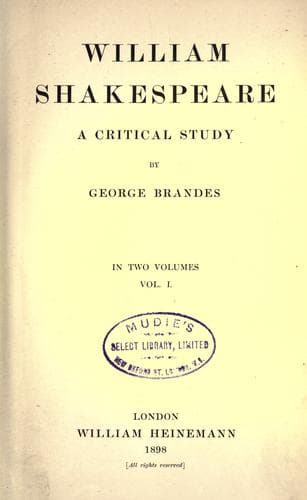
William Shakespeare: A Critical StudyBrandes, Georg
General
William Shakespeare: A Critical Study
Brandes, Georg
Shakespeare, William, 1564-1616 -- Criticism and interpretation
According to his custom, and in order to preserve continuity of style
with the foregoing plays, Shakespeare has interspersed _Henry V_.
with comic figures and scenes. Falstaff himself does not appear, his
death being announced at the beginning of the play; but the members
of his gang wander around, as living and ludicrous mementos of him,
until they disappear one by one by way of the gallows, so that nothing
may survive to recall the great king's frivolous youth. To console
us for their loss, we are here introduced to a new circle of comic
figures--soldiers from the different English-speaking countries which
make up what we now call the United Kingdom. Each of them speaks his
own dialect, in which resides much of the comic effect for English
ears. We have a Welshman, a Scot, and an Irishman. The Welshman is
intrepid, phlegmatic, somewhat pedantic, but all fire and flame for
discipline and righteousness; the Scot is immovable in his equilibrium,
even-tempered, sturdy, and trustworthy; the Irishman is a true Celt,
fiery, passionate, quarrelsome and apt at misunderstanding. Fluellen,
the Welshman, with his comic phlegm and manly severity, is the most
elaborate of these figures.
But in placing on the stage these representatives of the different
English-speaking peoples, Shakespeare had another and deeper purpose
than that of merely amusing his public with a medley of dialects. At
that time the Scots were still the hereditary enemies of England, who
always attacked her in the rear whenever she went to war, and the Irish
were actually in open rebellion. Shakespeare evidently dreamed of a
Greater England, as we nowadays speak of a Greater Britain. When he
wrote this play, King James of Scotland was busily courting the favour
of the English, and the question of the succession to the throne, when
the old Queen should die, was not definitely settled. Shakespeare
clearly desired that, with the coming of James, the old national hatred
between the Scotch and the English should cease. Essex, in Ireland,
was at this very time carrying out the policy which was to lead to
his destruction--that, namely, of smoothing away hatred by means of
leniency, and trying to come to an arrangement with the leader of the
Catholic rebellion. Southampton was with him in Ireland as his Master
of the Horse, and we cannot doubt that Shakespeare's heart was in the
campaign. Bates in this play (iv. I) probably expresses Shakespeare's
own political ideas when he says--
"Be friends, you English fools, be friends: we have French
[Spanish] quarrels enow, if you could tell how to reckon."
Public-domain text, read in full here on John Shaqi.
Reviews
Reviews
No reviews yet
Be the first to share your thoughts on this work.
Elsewhere in the archive
Join the Discussion
Join the discussion
Sign in to leave a comment or review.
Sign InorCreate an account