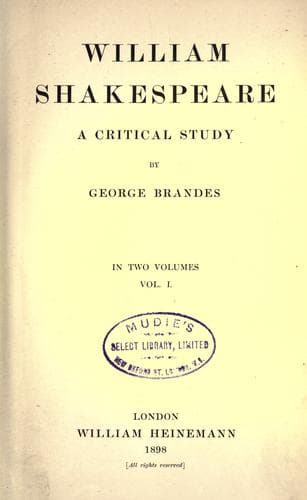
William Shakespeare: A Critical StudyBrandes, Georg
General
William Shakespeare: A Critical Study
Brandes, Georg
Shakespeare, William, 1564-1616 -- Criticism and interpretation
_Henry V_. is not one of Shakespeare's best plays, but it is one of
his most amiable. He here shows himself not as the almost superhuman
genius, but as the English patriot, whose enthusiasm is as beautiful
as it is simple, and whose prejudices, even, are not unbecoming. The
play not only points backward to the greatest period of England's past,
but forward to King James, who, as the Protestant son of the Catholic
Mary Stuart, was to put an end to religious persecutions, and who, as
a Scotchman and a supporter of the Irish policy of Essex, was for the
first time to show the world not only a sturdy England, but a powerful
Great Britain.
XXVI
_ELIZABETH AND FALSTAFF--THE MERRY WIVES OF WINDSOR--THE PROSAIC AND
BOURGEOIS TONE OF THE PIECE--THE FAIRY SCENES_
Shakespeare must have written _The Merry Wives of Windsor_ immediately
after _Henry V_., probably about Christmas 1599; for Sir Thomas Lucy,
on whom the poet here takes his revenge, died in 1600, and it is
improbable that Shakespeare would have cared to gird at him after his
death. He almost certainly did not write the piece of his own motive,
but at the suggestion of one whose wish was a command. There is the
strongest internal evidence for the truth of the tradition which states
that the play was written at the request of Queen Elizabeth. The first
Quarto of 1602 has on its title-page the words, "As it hath been divers
times acted by the right honourable my Lord Chamberlain's servants.
Both before Her Majesty, and elsewhere." A century later (1702), John
Dennis, who published an adaptation of the play, writes, "I know very
well that it had pleased one of the greatest queens that ever was
in the world.... This comedy was written at her command and by her
direction, and she was so eager to see it acted, that she commanded it
to be finished in fourteen days." A few years later (1709) Rowe writes,
"She was so well pleased with that admirable character of Falstaff in
the two parts of _Henry IV_., that she commanded him to continue it for
one play more and show him in love. This is said to be the occasion of
his writing _The Merry Wives_. How well she was obeyed, the play itself
is an admirable proof."
Public-domain text, read in full here on John Shaqi.
Reviews
Reviews
No reviews yet
Be the first to share your thoughts on this work.
Elsewhere in the archive
Join the Discussion
Join the discussion
Sign in to leave a comment or review.
Sign InorCreate an account