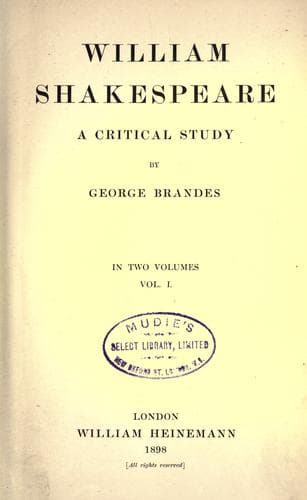
William Shakespeare: A Critical StudyBrandes, Georg
General
William Shakespeare: A Critical Study
Brandes, Georg
Shakespeare, William, 1564-1616 -- Criticism and interpretation
On the other hand, the old high spirits and the old wit now and again
flame forth in him, and a few of his speeches to Shallow, to Pistol, to
Bardolph and others are exceedingly amusing. He shows a touch of his
old self when, after having been soused in the water along with the
foul linen, he protests that drowning is "a death that I abhor, for the
water swells a man, and what a thing should I have been when I had been
swelled!" And he has a highly humorous outburst in the last act (v. 5)
when he declares, "I think the devil will not have me damned, lest the
oil that is in me should set hell on fire." But what are these little
flashes in comparison with the inexhaustible whimsicality of the true
Falstaff!
The play is more consistently farcical than any earlier comedy of
Shakespeare's, _The Taming of the Shrew_ not excepted. The graceful
and poetical passages are few. We have in Mr. and Mrs. Page a pleasant
English middle-class couple; and though the young lovers, Fenton and
Anne Page, have only one short scene together, they display in it
some attractive qualities. Anne Page is an amiable middle-class girl
of Shakespeare's day, one of the healthy and natural young women whom
Wordsworth has celebrated in the nineteenth century. Fenton, who is
said (though, we cannot believe it) to have been at one time a comrade
of Prince Hal and Poins, is certainly attached to her; but it is very
characteristic that Shakespeare, with his keen sense for the value of
money, sees nothing to object to in the fact that Fenton, as he frankly
confesses, was first attracted to Anne by her wealth. This is the same
trait which we found in another wooer, Bassanio, of a few years earlier.
Finally, there is real poetry in the short fairy scene of the last act.
The poet here takes his revenge for the prose to which he has so long
been condemned. It is full of the aromatic wood-scents of Windsor Park
by night. What is altogether most valuable in _The Merry Wives_ is its
strong smack of the English soil. The play appeals to us, in spite of
the drawbacks inseparable from a work hastily written to order, because
the poet has here for once remained faithful to his own age and his own
country, and has given us a picture of the contemporary middle-class;
in its sturdy and honest worth, which even the atmosphere of farce
cannot quite obscure.
[1] Dowden: _Shakspere--his Mind and Art_, p. 370.
XXVII
_SHAKESPEARE'S MOST BRILLIANT PERIOD--THE FEMININE TYPES BELONGING TO
IT--WITTY AND HIGHBORN YOUNG WOMEN--MUCH ADO ABOUT NOTHING--SLAVISH
FAITHFULNESS TO HIS SOURCES--BENEDICK AND BEATRICE--SPIRITUAL
DEVELOPMENT--THE LOW-COMEDY FIGURES_
Public-domain text, read in full here on John Shaqi.
Reviews
Reviews
No reviews yet
Be the first to share your thoughts on this work.
Elsewhere in the archive
Join the Discussion
Join the discussion
Sign in to leave a comment or review.
Sign InorCreate an account