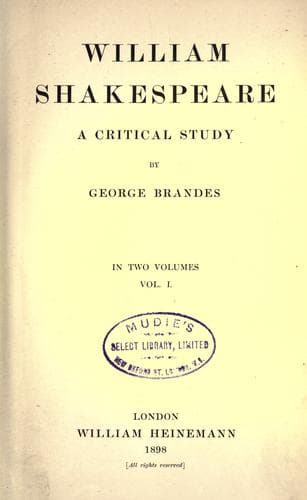
William Shakespeare: A Critical StudyBrandes, Georg
General
William Shakespeare: A Critical Study
Brandes, Georg
Shakespeare, William, 1564-1616 -- Criticism and interpretation
Nevertheless Shakespeare has here woven together no fewer than three
different actions--Falstaff's advances to the two Merry Wives,
Mrs. Ford and Mrs. Page, and all the consequences of his ill-timed
rendezvous; the rivalry between the foolish doctor, the imbecile
Slender, and young Fenton for the hand of fair Anne Page; and finally,
the burlesque duel between the Welsh priest and the French doctor,
which is devised and set afoot by the jovial Windsor innkeeper.
Shakespeare has himself invented much more than usual of the
complicated intrigue. But Falstaff's concealment in the buck-basket was
suggested by a similar incident in Fiorentino's _Il Pecorone_, from
which Shakespeare had already borrowed in the _Merchant of Venice_; and
the idea of making Falstaff incessantly confide his designs and his
rendezvous to the husband of the lady in question came from another
Italian story by Straparola, which had been published some ten years
earlier, under the title of _Two Lovers of Pisa_, in Tarlton's _News of
Purgatory_.
The invention is not always very happy. For instance, it is a highly
unpleasing and improbable touch that Ford, as Master Brook, should
bribe Falstaff to procure him possession of the woman (his own wife)
whom he affects to desire, and whom Falstaff also is pursuing.
Ford's jealousy, moreover, is altogether too stupid and crude in its
manifestations. But we have especially to deplore that the nature of
the intrigue and the moral tendency to be impressed on the play should
have made Falstaff, who used to be quickness and ingenuity personified,
so preternaturally dense that his incessant defeats afford his
opponents a very poor triumph.
He is ignorant of everything it would have been his interest to
know, and he is perpetually committing afresh the same inconceivable
blunders. It is foolish enough, in the first place, to write two
identical love-letters to two women in the same little town, who, as
he ought to know, are bosom friends. It is incredibly stupid of him
to walk three times in succession straight into the coarse trap which
they set for him; in doing so he betrays such a monstrous vanity that
we find it impossible to recognise in him the ironical Falstaff of the
Histories. It is inexpressibly guileless of him never to conceive the
slightest suspicion of "Master Brook," who, being his only confidant,
is therefore the only man who can have betrayed him to the husband.
And finally, it is not only childish, but utterly inconsistent with
the keen understanding of the earlier Falstaff, that he should believe
in the supernatural nature of the beings who pinch him and burn him by
night in the park.
Public-domain text, read in full here on John Shaqi.
Reviews
Reviews
No reviews yet
Be the first to share your thoughts on this work.
Elsewhere in the archive
Join the Discussion
Join the discussion
Sign in to leave a comment or review.
Sign InorCreate an account