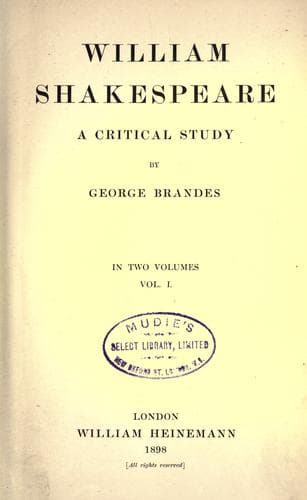
William Shakespeare: A Critical StudyBrandes, Georg
General
William Shakespeare: A Critical Study
Brandes, Georg
Shakespeare, William, 1564-1616 -- Criticism and interpretation
In spite of his latent melancholy, he is now highly-favoured and happy,
this young man of thirty-five; the sun of his career is in the sign
of the Lion,; he feels himself strong enough to sport with the powers
of life, and he now writes nothing but comedies. He does not take the
trouble to invent them; he employs his old method of carving a play
out of this or that mediocre romantic novel, or he revises inferior
old pieces. As a rule, he goes thus to work: he retains without a
qualm those traits in his fable which are fantastic, improbable,
even repulsive to a more delicate taste--such points are always
astonishingly unimportant in his eyes; he sometimes transfers to his
play undigested masses of the material before him, with no care for
psychological plausibility; but he seizes upon some leading situation
in the novel, or upon some single character in the earlier play, and
he animates this situation or this character, or (it may be) added
characters of his own invention, with the whole fervour of his soul,
until the speeches shine forth as in letters of fire, and sparkle with
wit or glow with passion.
Thus, in _Much Ado about Nothing_, he retains a fable which offers
almost insuperable difficulties to satisfactory poetical treatment, and
nevertheless produces, partly outside of its framework, poetical values
of the first order.
The play was entered in the Stationers' Register on the 4th of August
1600, and appeared in the same year under the title: _Much Adoe about
Nothing. As it hath been sundrie times publikely acted by the Right
Honourable the Lord Chamberlaine his Servants. Written by William
Shakespeare_. It must thus have been written in 1599 or 1600; and we
find, too, in its opening scene, certain allusions that accord with
this date. Thus Leonato's speech, "A victory is twice itself when the
achiever brings home full numbers," and Beatrice's "You had musty
victual," are both thought to point to Essex's campaign in Ireland.
Public-domain text, read in full here on John Shaqi.
Reviews
Reviews
No reviews yet
Be the first to share your thoughts on this work.
Elsewhere in the archive
Join the Discussion
Join the discussion
Sign in to leave a comment or review.
Sign InorCreate an account