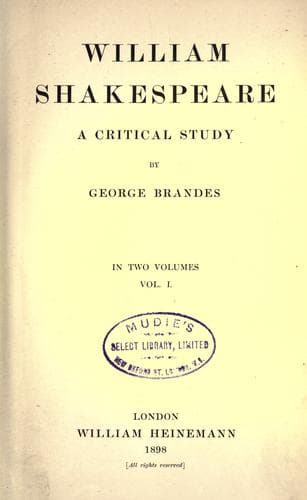
William Shakespeare: A Critical StudyBrandes, Georg
General
William Shakespeare: A Critical Study
Brandes, Georg
Shakespeare, William, 1564-1616 -- Criticism and interpretation
Shakespeare has taken the details of his plot from several Italian
sources. From the first book of Ariosto's _Orlando Furioso_ (the story
of Ariodante and Genevra), which was translated in 1591, and had
already provided the material for a play performed before the Queen
in 1582, he borrowed the idea of a malevolent nobleman persuading
a youthful lover that his lady is untrue to him, and suborning a
waiting-woman to dress like her mistress, and receive a nocturnal
visit by means of a ladder placed against her lady's window, so that
the bridegroom, watching the scene from a distance, may accept it as
proof of the calumny, and so break off the match. All the other details
he took from a novel of Bandello's, the story of Timbreo of Cardona.
Timbreo is represented by Claudio; through the medium of a friend, he
woos the daughter of Leonato, a nobleman of Messina. The intrigue which
separates the young pair is woven by Girondo (in Shakespeare, Don John)
just as in the play, but with a more adequate motive, since Girondo
himself is in love with the lady. She faints when she is accused, is
given out to be dead, and there is a sham funeral, as in the play. But
in the story it is represented that the whole of Messina espouses her
cause and believes in her innocence, while in the play Beatrice alone
remains true to her young kinswoman. The truth is discovered and the
engagement renewed, just as in Shakespeare.
Only for a much cruder habit of mind than that which prevails among
people of culture in our days can this story provide the motive for a
comedy. The very title indicates a point of view quite foreign to us.
The implication is that since Hero was innocent, and the accusation a
mere slander; since she was not really dead, and the sorrow for her
loss was therefore groundless; and since she and Claudio are at last
married, as they might have been at first--therefore the whole thing
has been much ado about nothing, and resolves itself in a harmony which
leaves no discord behind.
Public-domain text, read in full here on John Shaqi.
Reviews
Reviews
No reviews yet
Be the first to share your thoughts on this work.
Elsewhere in the archive
Join the Discussion
Join the discussion
Sign in to leave a comment or review.
Sign InorCreate an account