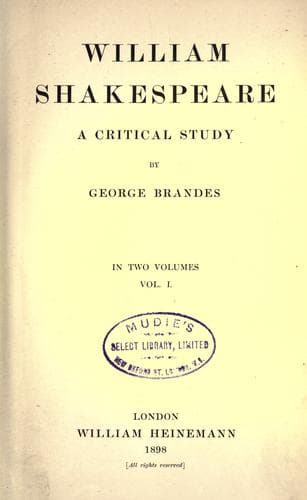
William Shakespeare: A Critical StudyBrandes, Georg
General
William Shakespeare: A Critical Study
Brandes, Georg
Shakespeare, William, 1564-1616 -- Criticism and interpretation
When we moderns, however, think of _Much Ado about Nothing,_ it is not
this distasteful story that rises before our mind's eye. It is Benedick
and Beatrice, and the intrigue in which they are involved. The light
from these figures, and especially from that of Beatrice, irradiates
the play, and we understand that Shakespeare was forced to make Claudio
so contemptible, because by that means alone could the enchanting
personality of Beatrice shine forth in its fullest splendour.
Beatrice is a great lady of the Renaissance in her early youth,
overflowing with spirits and energy, brightly, defiantly virginal,
inclined, in the wealth of her daring wit, to a somewhat aggressive
raillery, and capable of unabashed freedom of speech, astounding to our
modern taste, but permitted by their education to the foremost women of
that age. Her behaviour to Benedick, whom she cannot help perpetually
twitting and teasing, is as headstrong and refractory as Katharine's
treatment of Petruchio.
Her diction is marvellous, glittering with unrestrained fantasy. For
instance, after she has assured her uncle (ii. I) that she "is on
her knees every morning and evening" to be spared the infliction of
a husband, since a man with a beard and a man without one would be
equally intolerable to her, she proceeds--
"_Beatrice_. ... Therefore I will even take sixpence in
earnest of the bear-ward, and lead his apes into hell.
"_Leonato_. Well, then, go you into hell?
"_Beat_. No; but to the gate; and there will the devil meet
me, like an old cuckold, with horns on his head, and say,
'Get you to heaven, Beatrice, get you to heaven; here's no
place for you maids:' so deliver I up my apes, and away to
Saint Peter for the heavens; he shows me where the bachelors
sit, and there live we as merry as the day is long."
She holds that--
"Wooing, wedding, and repenting, is as a Scotch jig, a
measure, and a cinque-pace: the first suit is hot and hasty,
like a Scotch jig, and full as fantastical; the wedding,
mannerly modest, as a measure, full of state and ancientry;
and then comes repentance, and with his bad legs falls into
the cinque-pace faster and faster, till he sink into his
grave."
Therefore she exclaims with roguish irony--
"Good Lord, for alliance!--Thus goes every one to the world
but I, and I am sun-burnt. I may sit in a corner, and cry
heigh-ho for a husband!"
In her battles with Benedick she outdoes him in fantasy, both congruous
and incongruous, or burlesque. Here, again, Shakespeare has evidently
taken Lyly as his model, and has tried to reproduce the polished facets
of his dialogue, while at the same time correcting its unnaturalness,
and giving it fresh life. And Beatrice follows up her victory over
Benedick, even when he is no longer her interlocutor, with a freedom
which is now-a-days unthinkable in a young girl:--
"_D. Pedro_. You have put him down, lady; you have put him
down.
Public-domain text, read in full here on John Shaqi.
Reviews
Reviews
No reviews yet
Be the first to share your thoughts on this work.
Elsewhere in the archive
Join the Discussion
Join the discussion
Sign in to leave a comment or review.
Sign InorCreate an account