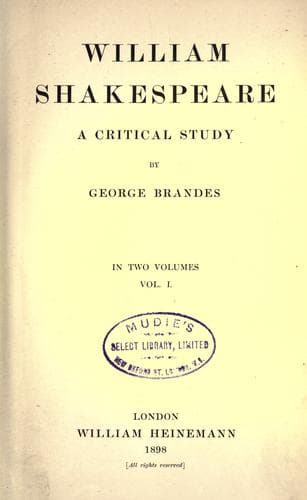
William Shakespeare: A Critical StudyBrandes, Georg
General
William Shakespeare: A Critical Study
Brandes, Georg
Shakespeare, William, 1564-1616 -- Criticism and interpretation
The ear of the modern reader is otherwise attuned. He recognises,
indeed, that Shakespeare has taken no small pains to make this fable
dramatically acceptable. He appreciates the fact that here again, in
the person of Don John, the poet has depicted mere unmixed evil, and
has disdained to supply a motive for his vile action in any single
injury received, or desire unsatisfied. Don John is one of the sour,
envious natures which suck poison from all sources, because they suffer
from the perpetual sense of being unvalued and despised. He is, for
the moment, constrained by the forbearance with which his victorious
brother has treated him, but "if he had his mouth he would bite." And
he does bite, like the cur and coward he is, and makes himself scarce
when his villainy is about to be discovered. He is an ill-conditioned,
base, and tiresome scoundrel; and, although he conscientiously does
evil for evil's sake, we miss in him all the defiant and brilliantly
sinister qualities which appear later on in Iago and in Edmund. There
is little to object to in Don John's repulsive scoundrelism; at most we
may say that it is a strange motive-power for a comedy. But to Claudio
we cannot reconcile ourselves. He allows himself to be convinced, by
the clumsiest stratagem, that his young bride, in reality as pure
and tender as a flower, is a faithless creature, who deceives him
the very day before her marriage. Instead of withdrawing in silence,
he prefers, like the blockhead he is, to confront her in the church,
before the altar, and in the hearing of every one overwhelm her with
coarse speeches and low accusations; and he induces his patron, the
Prince Don Pedro, and, even the lady's own father, Leonato, to join
him in heaping upon the unhappy bride their idiotic accusations.
When, by the advice of the priest, her relatives have given her out
as dead, and the worthy old Leonato has lied up hill and down dale
about her hapless end, Claudio, who now learns too late that he has
been duped, is at once taken into favour again. Leonato only demands
of him--in, accordance with the mediæval fable--that he shall declare
himself willing to marry whatever woman he (Leonato) shall assign to
him. This he promises, without a word or thought about Hero; whereupon
she is placed in his arms. The original spectators, no doubt, found
this solution satisfactory; a modern audience is exasperated by it,
very much as Nora, in _A Doll's House_, is exasperated on finding that
Helmer, after the danger has passed away, regards all that has happened
in their souls as though it had never been, merely because the sky
is clear again. If ever man was unworthy a woman's love, that man is
Claudio. If ever marriage was odious and ill-omened, this is it. The
old taleteller's invention has been too much even for Shakespeare's art.
Public-domain text, read in full here on John Shaqi.
Reviews
Reviews
No reviews yet
Be the first to share your thoughts on this work.
Elsewhere in the archive
Join the Discussion
Join the discussion
Sign in to leave a comment or review.
Sign InorCreate an account