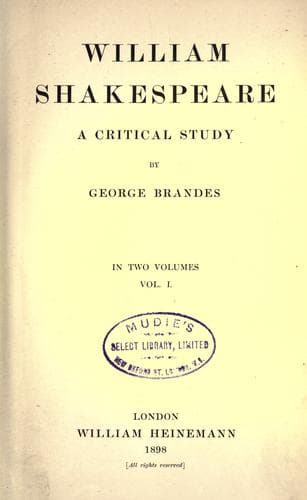
William Shakespeare: A Critical StudyBrandes, Georg
General
William Shakespeare: A Critical Study
Brandes, Georg
Shakespeare, William, 1564-1616 -- Criticism and interpretation
As usual, Shakespeare took from another poet the whole material of this
enchanting comedy. His contemporary, Thomas Lodge (who, after leaving
Oxford, became first a player and playwright in London, then a lawyer,
then a doctor and writer on medical subjects, until he died of the
plague in the year 1625), had in 1590 published a pastoral romance,
with many poems interspersed, entitled _Euphues golden Legacie, found
after his death in his Cell at Silexedra_,[1] which he had written,
as he sets forth in his Dedication to Lord Hunsdon, "to beguile the
time" on a voyage to the Canary Islands. The style is laboured and
exceedingly diffuse, a true pastoral style; but Lodge had that gift of mere
external invention in which Shakespeare, with all his powers, was so
deficient. All the different stories which the play contains or touches
upon are found in Lodge, and likewise all the characters, with the
exception of Jaques, Touchstone, and Audrey. Very remarkable to the
attentive reader is Shakespeare's uniform passivity with regard to
what he found in his sources, and his unwillingness to reject or alter
anything, combined as it is with the most intense intellectual activity
at the points upon which he concentrates his strength.
We find in _As You Like It_, as in Lodge, a wicked Duke who has
expelled his virtuous brother, the lawful ruler, from his domains.
The banished Duke, with his adherents, has taken refuge in the Forest
of Arden, where they live as free a life as Robin Hood and his merry
men, and where they are presently sought out by the Duke's daughter
Rosalind and her cousin Celia, the daughter of the usurper, who will
not let her banished friend wander forth alone. In the circle of
nobility subordinate to the princes, there is also a wicked brother,
Oliver, who seeks the life of his virtuous younger brother, Orlando,
a hero as modest and amiable as he is brave. He and Rosalind fall in
love with each other the moment they meet, and she makes sport with him
throughout the play, disguised as a boy. These scenes should probably
be acted as though he half recognised her. At last all ends happily.
The wicked Duke most conveniently repents; the wicked brother is all
of a sudden converted (quite without rhyme or reason) when Orlando,
whom he has persecuted, kills a lioness--a lioness in the Forest of
Arden!--which is about to spring upon him as he lies asleep. And the
caitiff is rewarded (no less unreasonably), either for his villainy or
for his conversion, with the hand of the lovely Celia.
This whole story is perfectly unimportant; Shakespeare, that is to
say, evidently cared very little about it. We have here no attempt at
a reproduction of reality, but one long festival of gaiety and wit, a
soulful wit that vibrates into feeling.
Public-domain text, read in full here on John Shaqi.
Reviews
Reviews
No reviews yet
Be the first to share your thoughts on this work.
Elsewhere in the archive
Join the Discussion
Join the discussion
Sign in to leave a comment or review.
Sign InorCreate an account